
Whilst Ebenezer Howard envisioned city dwellers returning to the countryside in the Garden City, Le Corbusier proposed the opposite: that the countryside should enter the city. It was in 1933 that the Franco-Swiss architect presented his Ville Radieuse —the Radiant City—, an urban utopia designed to banish, through reason and technology, the chaos into which the nineteenth century had plunged industrial metropolises. It was a sweeping overhaul of traditional urban planning and a commitment to an orderly future from the foundations to the sky.
For Le Corbusier, housing should be, above all, a machine for living in—in other words, a functional space, precise and stripped of all superfluous ornamentation. His proposal consisted of nothing less than demolishing the congested historic centres—considered beyond redemption from a hygienist and functional perspective—and replacing them with gigantic cruciform skyscrapers, made of glass and steel, arranged with mathematical precision.
By building homes in towers, up to 95% of the ground space was freed up, leaving it exclusively for landscaping. The result was a city where citizens literally lived in the clouds, surrounded by light and fresh air, whilst at their feet stretched an ocean of parks, public gardens and open spaces. All in all, the Radiant City introduced three concepts that profoundly influenced 20th-century urban planning. Let’s take a look at them:
The first was strict zoning: the city’s spaces were divided by function, with specific, clearly defined sectors for living, working, moving about and enjoying leisure. These sectors were never to be mixed or confused, for it was precisely in their separation, according to Le Corbusier, that lay the secret to eliminating the conflicts and congestion characteristic of the nineteenth-century city.
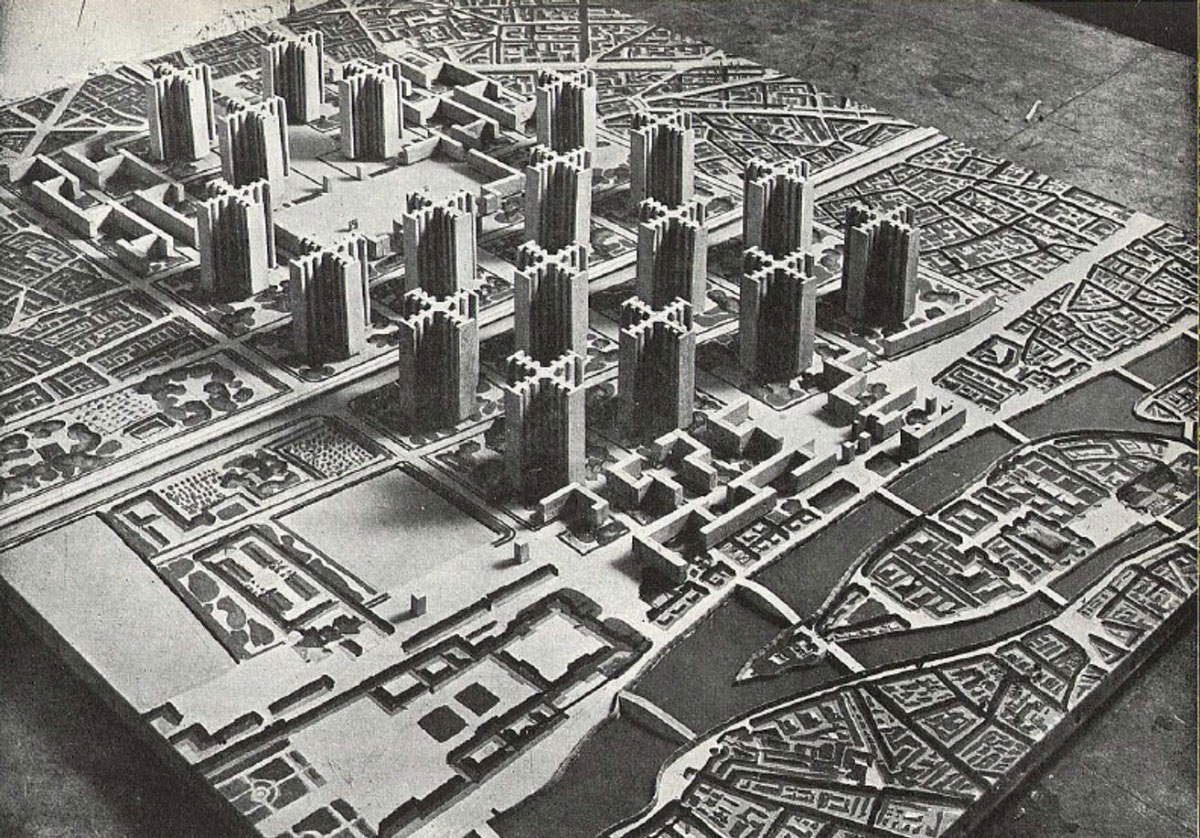
WaskoGM / deviantart.com
The second concept was the establishment of the car as the backbone of mobility within the urban environment. The design prioritised large elevated motorways, with fast and uninterrupted traffic flow, thereby eliminating the traditional street. Pedestrians were relegated to gardens and footbridges, completely separated from the noisy flow of motor vehicles.
The third principle was that of standardisation, or, in other words, a universalist approach. Everything in the Radiant City—from residential blocks to street furniture—had to be designed according to an industrial logic so that it could be replicated anywhere in the world. And this was done without any consideration for the specific topographical, climatic or cultural characteristics of each location.
Although the Radiant City was never actually built as such, its three principles or concepts, we must emphasise, had a significant influence—sometimes contradictory—on subsequent urban planning. The construction of Brasília—Brazil’s planned capital, now a UNESCO World Heritage Site—is a prime example; as are the large social housing estates that sprang up on the outskirts of cities across the globe, from Europe to Latin America.
However, the rigidity of Le Corbusier’s model was also its undoing. By separating urban functions so strictly—the workplace from housing, living space from leisure, and leisure from circulation—it stripped the street of its role as a space for social interaction and life. The streets thus became functional, cold, emotionally sterile places that hindered or directly prevented community life.
By David González Molina, BIM Manager in the Architecture Department at Amusement Logic