
Theme parks, hotels and resorts, water parks, tourist attractions and immersive leisure projects in general have a real opportunity to incorporate climbing as a recreational activity that goes beyond the purely sporting sphere. What was once a technical and endurance-based discipline reserved for a select few enthusiasts is now becoming an accessible and appealing activity for a wider audience. Indeed, theming using artificial rock makes this possible in a way that conventional climbing walls cannot match.
Indeed, unlike standard climbing walls, where coloured holds and wooden or fibre boards cannot hide their nature as schematic sports infrastructure, artificial rock allows for the recreation of geological formations found in real landscapes. Layers, cracks, ledges and overhangs are precisely modelled to make the sensation of facing a natural wall feel real.
However, whilst the surfaces must achieve that organic appearance—as if they had been sculpted by centuries of erosion—every hold, every foothold and every incline must meet precise criteria of ergonomics, safety and graded difficulty. It is the use of theming techniques that allows this technical logic to be seamlessly integrated into the landscape, so that the overall impression is entirely natural.
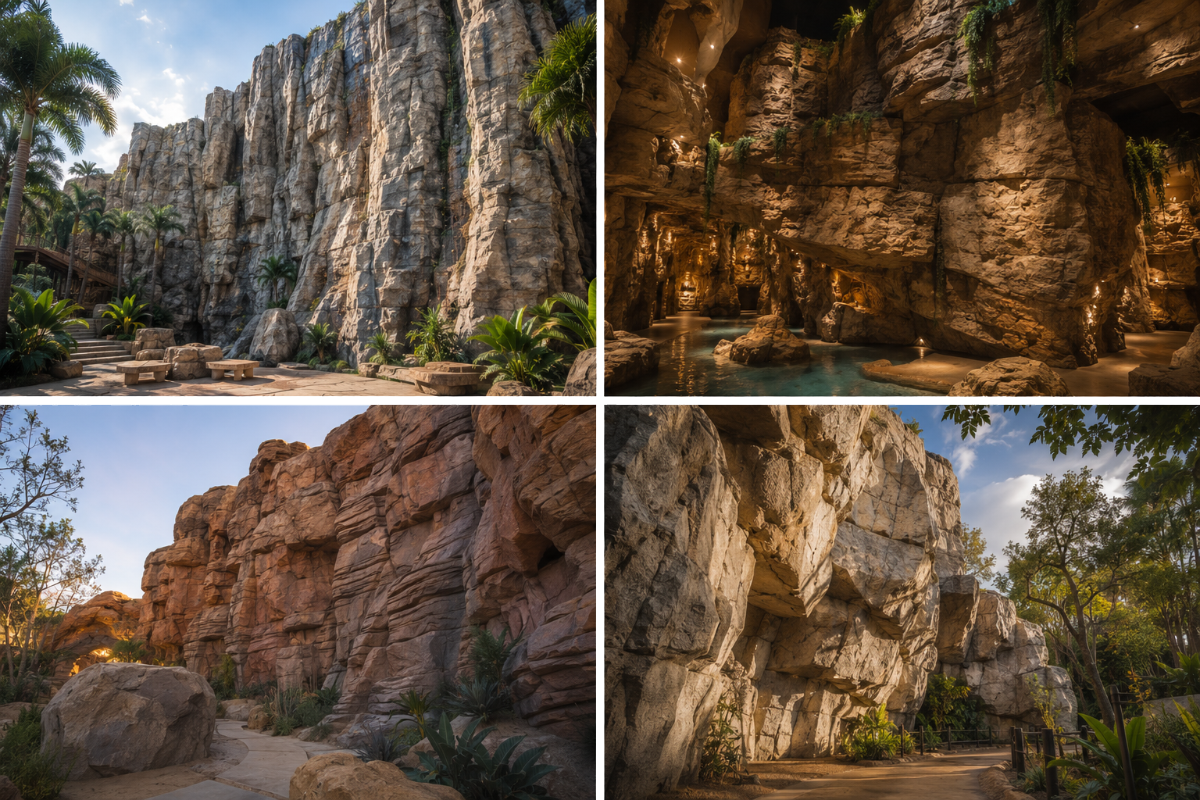
This makes it possible to develop climbing and canyoning experiences that are tailored to different contexts and audiences. From areas integrated into water parks—the proximity of water will require specific materials—to rock areas whose theming recreates giant boulders that an ancient glacier might have dragged along, scattered throughout a forest or a rocky canyon. Vertical routes are also designed in mountain resorts or indoor spaces inspired by caves, volcanic formations or desert landscapes.
The unique value of using artificial rock for thematic design lies in its extraordinary ability to reproduce specific geological features. Using sculptural techniques and surface treatments with pigments, inks and sealants — including hand-modelling on formwork, casting from moulds or sprayed concrete — the team simulates limestone walls with their characteristic sharp edges, wind-eroded sandstone, volcanic formations with a rough texture, or even travertine waterfalls.
By Cristina Uchán, senior architect in the Architecture Department at Amusement Logic