
Whilst Le Corbusier designed an urban plan that brought nature into the city — as we saw in our article on the Radiant City — and Howard devised an urban development that brought the city into nature — as we also saw in the article on the Garden City — Clarence Perry, by contrast, proposed an urban design with the child walking to school in mind. It was in 1929, as part of the New York Regional Plan, that Perry presented his concept of the ‘neighbourhood unit’. This was an urban planning proposal which, at a time when the car was being glorified, shifted the focus back to the human scale and the everyday lives of the city’s inhabitants.
Perry proposed situating the primary school at the geographical heart of the neighbourhood and at the centre of the community. His idea was as logical as it was revolutionary – and just as relevant a century later: the dimensions of the neighbourhood should not be determined by a property developer or market forces, but by the distance a child can safely walk to reach their school. This simple premise shifted the focus of urban planning from road efficiency to the protection of the most vulnerable, and established a new hierarchy in which the pedestrian scale took precedence over that of the car.
To make the neighbourhood a living community, Perry proposed that the major avenues and heavy traffic should run around its perimeter and never pass through it. Quiet streets were to encourage walking and play, and essential facilities — schools, parks, shops, etc. — were to be situated at a maximum distance of between 400 and 800 metres or, in human terms, within a 5- to 10-minute walk. To ensure daily contact with nature, at least 10 per cent of the neighbourhood’s area was to be set aside for parks and recreational spaces. Finally, shops were to be situated so as to serve the neighbourhood, but on its outskirts and at the junctions of main roads, to keep the hustle and bustle and traffic out of residential areas.
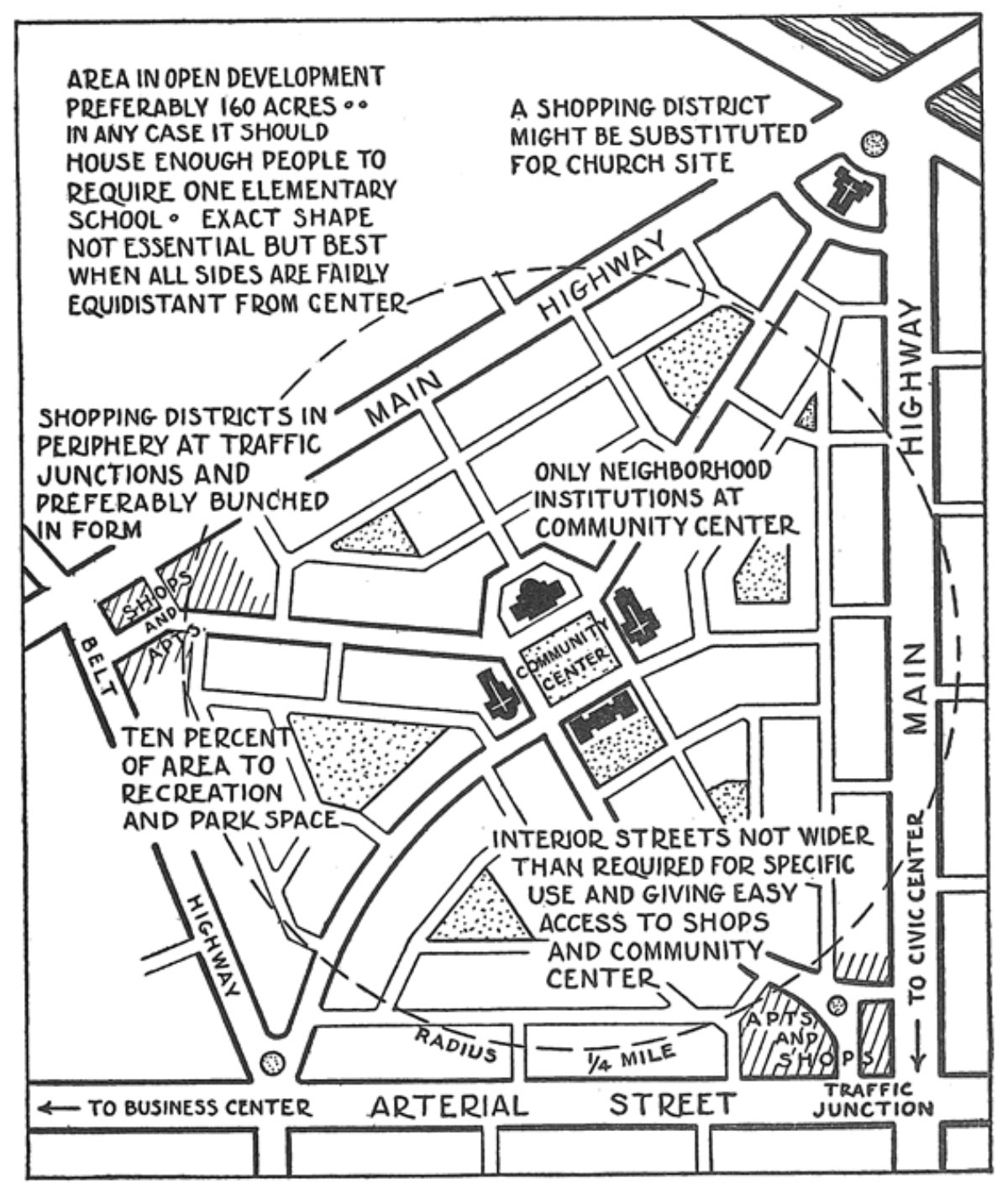
As we were saying, Perry’s model is the direct precursor to what we now know as ‘15-minute cities’. His greatest insight was to understand that a city is not merely a place of transit, but a social habitat that possesses a unique sense of cohesion thanks to proximity, interaction and safety. Perry understood that a community is not built on large-scale infrastructure, but on the peace of mind that comes from a child being able to cross the road without fear, an adult being able to buy bread without taking the car, and neighbours meeting up in the park to chat.
Here are links to articles on Le Corbusier’s and Howard’s proposals, if you’d like to find out more:
» The city garden: the dream of perfect equilibrium
» The vertical utopia: when Le Corbusier wanted to bring the countryside to the city
By David González Molina, BIM manager in the Architecture Department at Amusement Logic