
In the development of any leisure and tourism project—be it a hotel or resort, a water park or theme park, or any other venture—the terrain always introduces a degree of uncertainty. Its exact characteristics defy the pinpoint precision of the design. No matter how finely the structural calculations are refined or how closely the construction processes are monitored, the subsoil resists being predicted with absolute accuracy.
Traditionally, geotechnical engineering operates using interpretative models based on static hypotheses which, once earthworks are underway, often prove to be incomplete or overly simplified. However, the integration of geotechnical data into BIM (Building Information Modelling) environments allows the subsoil to be transformed into a living digital asset.
By incorporating stratigraphic profiles, groundwater levels, internal friction angles and compressibility coefficients, uncertainty—while not entirely eliminated—becomes quantifiable, visible and, above all, manageable within the three-dimensional model from the very early stages of the project. This is all the more true when these parameters are particularly critical in unique projects such as those often found in leisure and tourism, namely water parks, theme parks, hotels or resorts, campsites, etc.
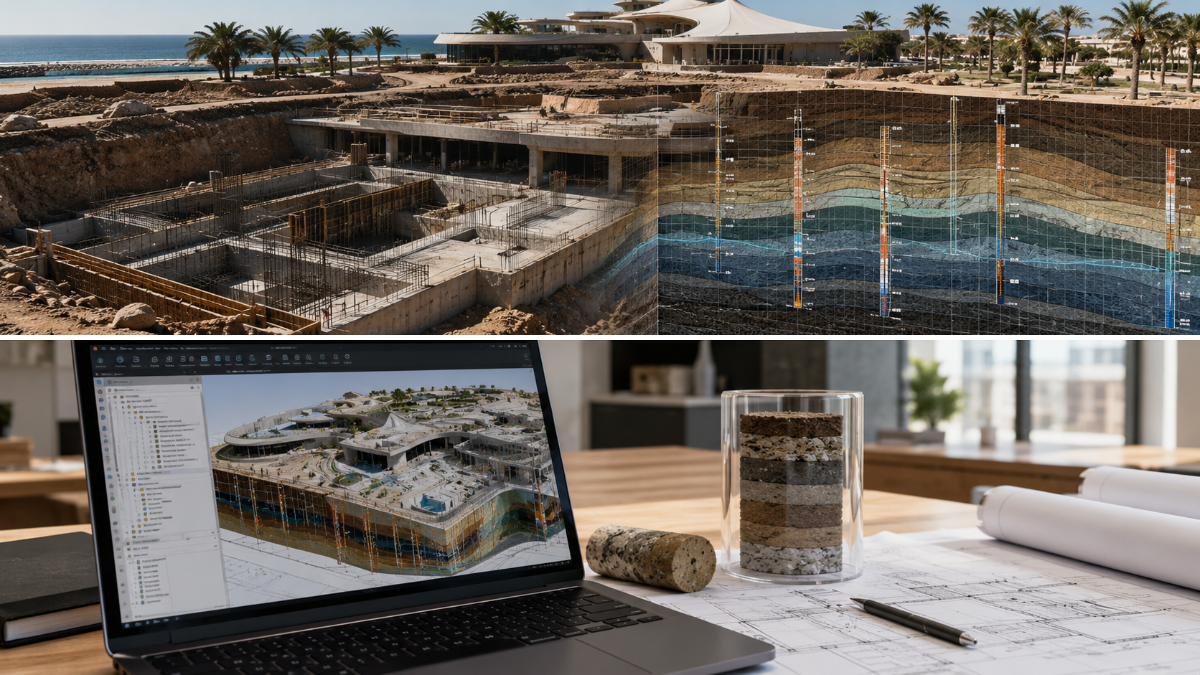
In this type of facility, the architecture demands great formal freedom and constant integration with the surroundings. Uneven ground, open esplanades and a topography that is rarely uniform determine the foundations of major attractions or the positioning of swimming pools. Linking the actual behaviour of the ground with structural precision and the exact detailing of the reinforcement allows project teams to anticipate unforeseen scenarios — such as differential settlement or the need for remedial works — and to update solutions quickly as real-time data is obtained on site. The BIM methodology therefore becomes a dynamic tool that directly links theoretical calculations with what actually happens on site. It does not eliminate uncertainty—which is impossible when working with the terrestrial substrate—but rather incorporates it as another variable in the decision-making process. After all, public safety is the primary requirement in architecture and construction in general, and in particular in leisure and tourism facilities such as water parks or theme parks, hotels, resorts, and campsites, amongst others.
By Isabel Gonzalo, Senior Modeller in the Architecture Department at Amusement Logic