

Electric vehicles and scooters, batteries built into countless devices… Electrification is a massive, global phenomenon. However, it has brought with it an unexpected danger: fires involving lithium-ion batteries and accumulators. Conventional fire extinguishers — whether dry chemical powder, foam or carbon dioxide — are, at best, of limited effectiveness in putting them out. In response to this issue, international regulations have established a new standard: Class L fire extinguishers.
As mentioned, standard dry chemical powder is of little use against a battery fire, which generates its own oxygen internally through thermal decomposition reactions. This requires a substance with extreme cooling capacity, such as that exhibited by the agents in Class L fire extinguishers. These typically use aqueous solutions with specific additives or dispersions of hydrated vermiculite. These solutions reduce the temperature of the battery cells to below 120 or 150 degrees Celsius, the threshold at which the chain reaction becomes irreversible and self-sustaining.
Furthermore, many of these agents incorporate a micellar encapsulation mechanism. In other words, the substances contained in Class L fire extinguishers surround the molecules of the flammable electrolyte, effectively trapping them so that they cannot react with heat, thereby preventing the fire from spreading. When applied, they form a physical barrier—ceramic or gel-like in nature—that prevents oxygen from entering the cells not yet affected. At the same time, and this is important, they block the release of toxic gases—such as hydrogen fluoride—which are dangerous to emergency crews and bystanders.
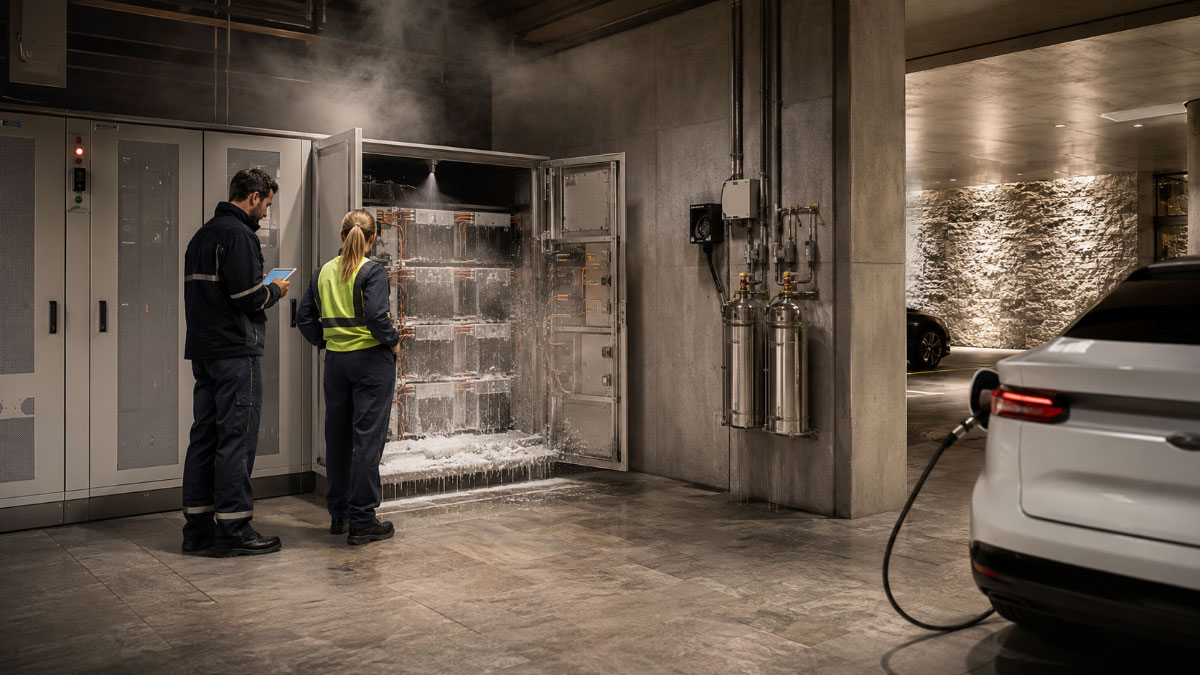
In the European context, the UNE-EN 3-7 standard sets out the performance tests that portable fire extinguishers must pass to obtain Class L certification. Additionally, the NFPA 855 standard, from the US National Fire Protection Association, serves as a benchmark for the installation of energy storage systems. In either case, both insurers and public authorities are beginning to demand an analysis of the hazards posed by accumulators and batteries.
By Juan Carlos Soria, Senior MEP Engineer in the Architecture Department at Amusement Logic