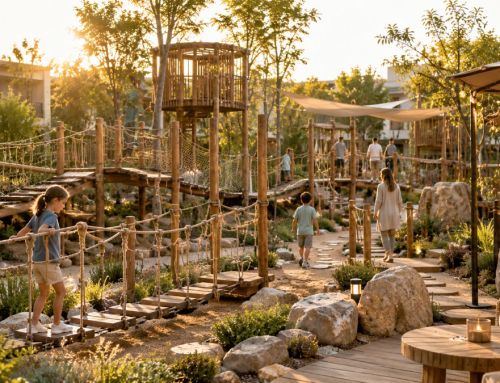

Street furniture often consists of a series of identical elements conveniently distributed throughout the city’s streets and/or parks. However, this proposal from Amusement Logic’s Design Department explores a different approach: benches cease to be isolated pieces and instead become continuous meeting spaces. Their forms complement the landscape and facilitate different visual perspectives and ways for people to interact.
The continuous, meandering geometry of this street furniture is accompanied by a water feature, the banks of which it runs along for the greater enjoyment of the public. The design of its layout is driven not so much by ornamental considerations as by the comfort and versatility of its use. It consists of a succession of small areas for public conversation, from which one can contemplate the ceaseless movement of a waterfall and listen to the musical bubbling of the water. The backrests form an enveloping embrace. All in all, the constantly evolving forms break away from the monotonous repetition found in conventional street furniture.
The design of these public benches is based on a parametric system. Rather than designing each section of the furniture independently, rules are established to determine its behaviour, namely: the maximum seat height, the maximum width, the radii of curvature and the direction of the views. The system enables the street furniture to adapt to the space and the specific conditions of its location.
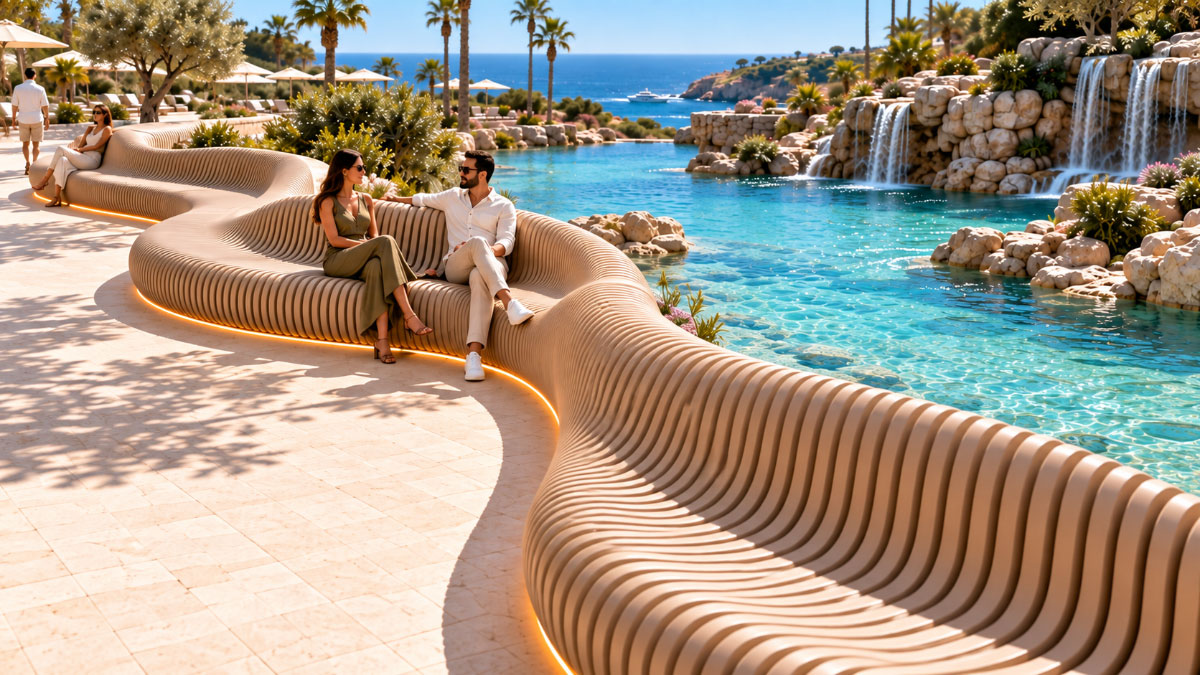
A continuous strip with vertical ribs extends with small, successive variations. This distinctive repetition creates a sense of identity without uniformity. The parametric moulds are manufactured using computerised numerical control technology, which facilitates modularity, making the furniture easy to transport and allowing modules to be replaced without the need for major alterations.
Street furniture is no longer merely an addition, but rather delimits the space. To put it another way, the continuous bench helps to define public space. Its layout guides movement, whilst separating circulation areas from rest areas.
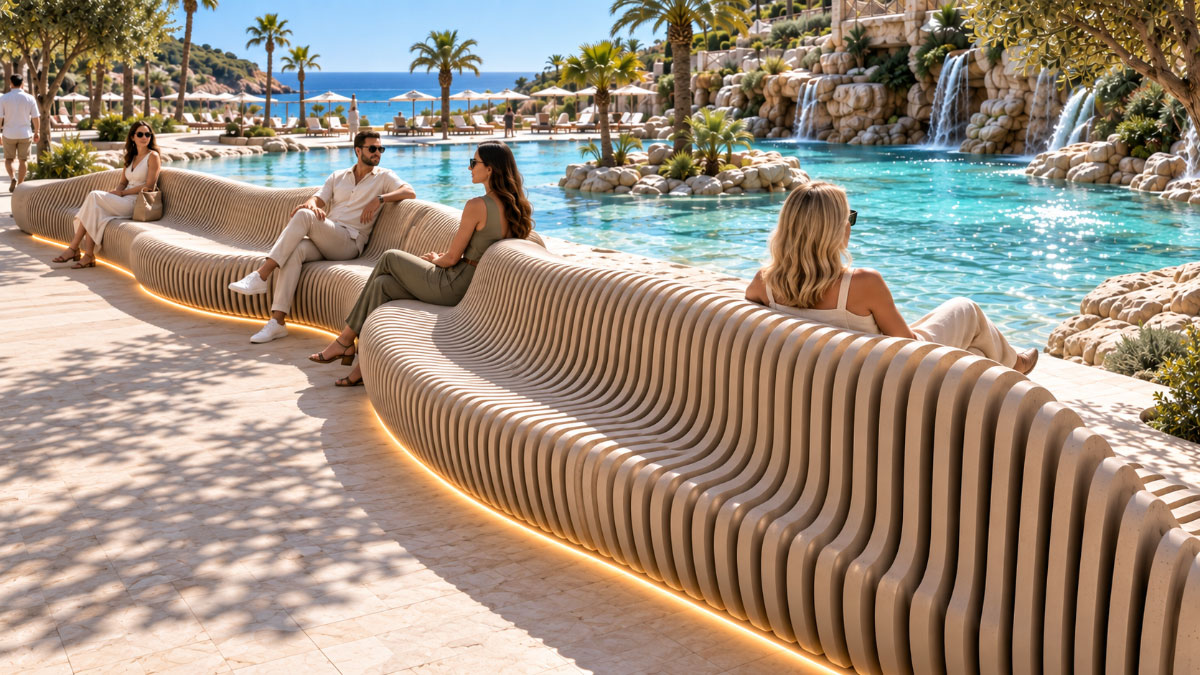
The warm, continuous under-lighting – barely a brushstroke – makes the street furniture appear as a floating mass above the pavement. It enhances perception and facilitates movement at night. It complements a geometry that aids intuitive orientation, without the need for barriers or signs. A geometry whose meandering form moves away from frontal compositions, allowing people to occupy various positions for different degrees of interaction, both at night and during the day.