
At the end of the 19th century, smoke, overcrowding and congestion, along with disease, made the streets and skies of industrial cities grey, unhealthy and dreary places. In that context, in 1898, a parliamentary stenographer with no formal architectural training published a visionary proposal that changed urban planning: he was Ebenezer Howard, and his idea was the garden city.
Howard explained his idea simply: the city offered wages and social life, but at the cost of polluted air. The countryside offered nature and clean air, but lacked employment opportunities and, practically speaking, social life. So, what if the best of both could be combined? Thus emerged the idea of the country-town: a place with urban opportunities alongside the health and wellbeing of a rural environment.
picryl.com
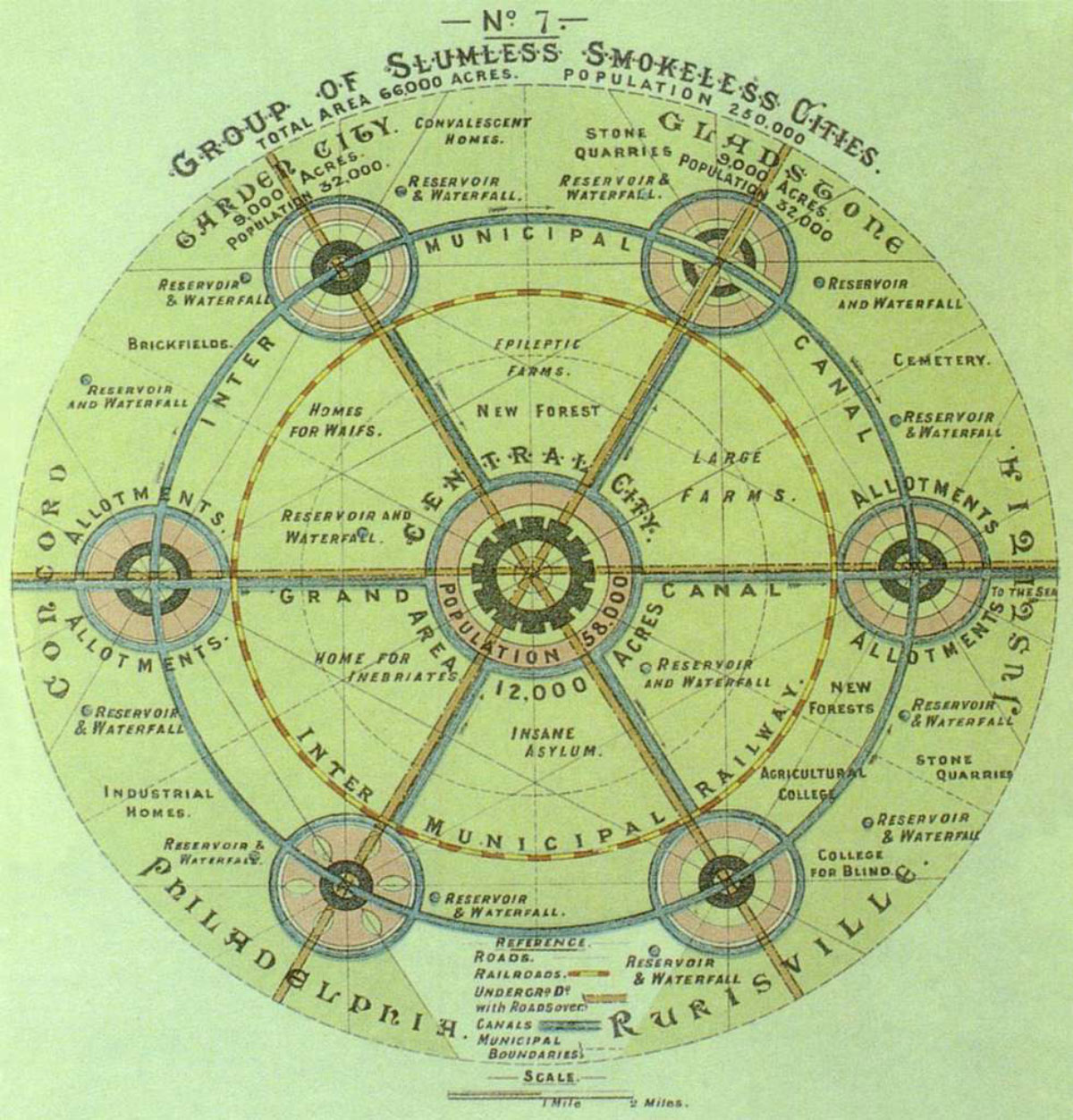
For the model to work, unlike cities that expand without control, the garden city was to grow only to a set population limit (around 32,000 people). Once that limit was reached, another nearby city would be founded. In terms of design, the garden city had a concentric layout: a public core, housing with gardens around it, and a green belt reserved for agricultural land to guarantee local employment and curb expansion. Moreover, the land was to be held in common ownership to prevent speculation.
Experimental attempts at garden cities, such as the first in the world, Letchworth Garden City — which also features one of the earliest roundabouts in the world and, consequently, the first in the United Kingdom — did not achieve full self-sufficiency, but they served as a model for other urban developments and their influence endures to this day. After all, Howard’s idea introduced concepts that are now applied and taken for granted in modern urban planning: green spaces and urban parks, density control, and the principle that residents’ wellbeing should be prioritised.

By David González Molina, BIM Manager, Architecture Department, Amusement Logic