
When a family visits a water park, they don’t just consider the attractions on offer; at the end of the day, they take stock and evaluate the complete experience for all their members, from the youngest to the oldest. But that experience begins long before they climb onto the first slide, dive into the first swimming pool, or grab the first float to head down the lazy river.
Indeed, the family’s experience at a water park unfolds in its public area—that is, in all its visible and accessible spaces and pathways. This public area is part of the strategy that directly influences the perceived value of the park, or, in other words, the family members’ decisions regarding how long they spend there. This ultimately impacts the project’s profitability.
The first impression the water park makes is key to the family’s perception of its value. The experience begins at the entrance, whether with public transport or in the car park after leaving their vehicle. The ticket purchase process and access control are also integrated into what we might call this first part of the experience.
Specifically, the design of the entrance and reception areas creates an immediate impact, reinforces the project’s identity, justifies the ticket price, and encourages visitors to share their experience on social media. A particularly effective strategy involves installing and building iconic elements, landmarks, or monuments that tempt visitors to take photos. As well as staying in visitors’ memories, these points of interest boost the park’s digital presence.
Once families have entered inside the water park, they should be able to move around intuitively and smoothly, without crowding or disorientation. Organising circulation flows in the design is fundamental in this regard; it avoids congestion points, distributes traffic evenly, and facilitates wayfinding through clear and consistent signage. Family members enjoy themselves more and, consequently, spend more time inside the park. And this extended stay, of course, has a direct impact on their spending and, therefore, on the water park’s financial results.
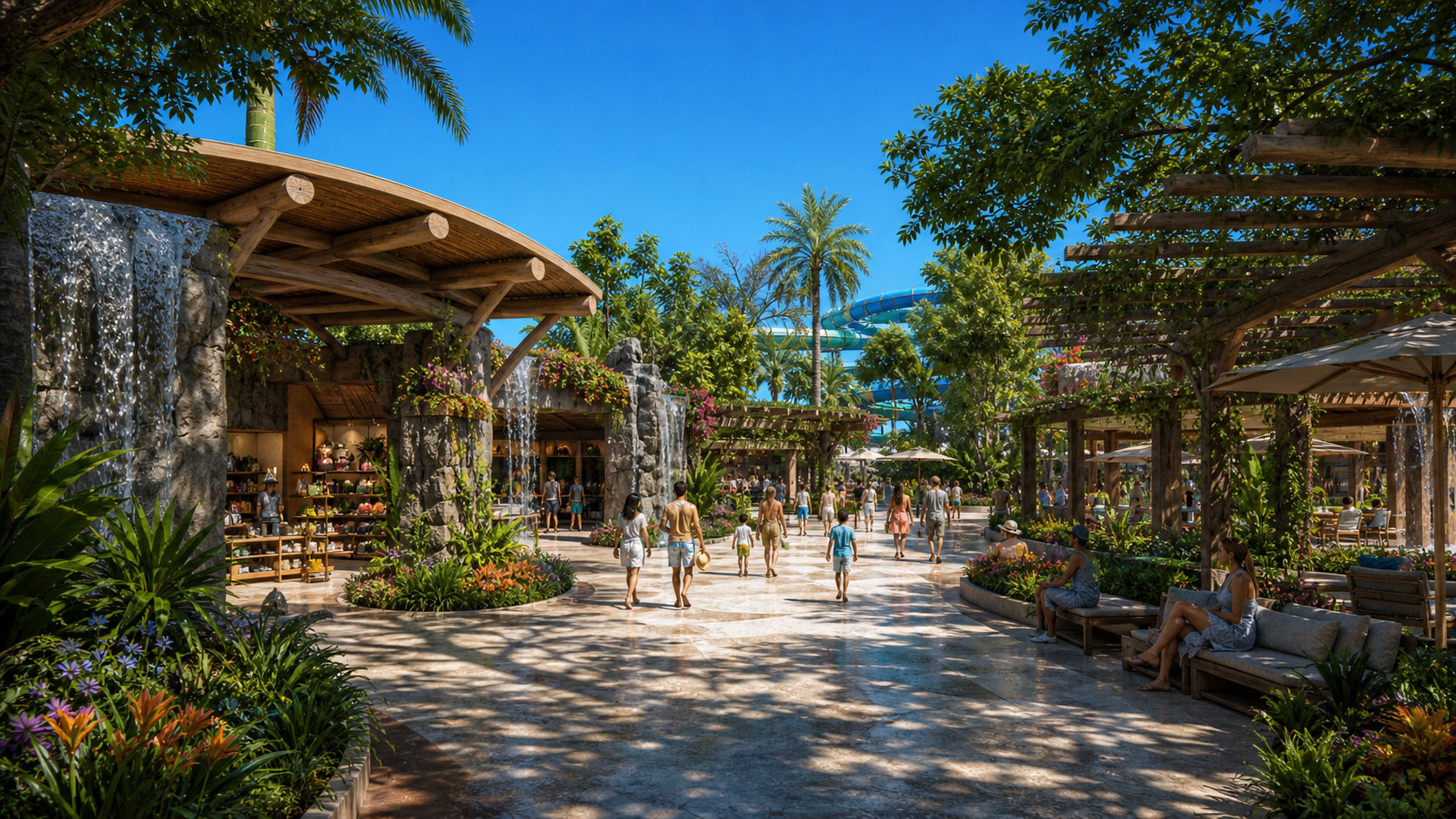
The public area also plays an important role in generating additional revenue. The strategic placement of restaurants, shops, and rest areas allows families to be engaged at opportune moments—for example, after an intense ride or during a natural break—and therefore organically and unobtrusively encourage spending.
Comfort is another decisive factor in the behaviour of this typical family. In a water park, aspects such as the availability of shaded areas, the existence of well-distributed rest areas, the use of climate-appropriate materials, and easy access to restrooms and food services directly influence the overall perception of the experience.
Finally, a well-designed water park’s public areas consider its future, not as a static destination, but as a dynamic continuum. In this way, it anticipates new attractions, as well as the potential adaptation of spaces to different types of visitors. This capacity for evolution is crucial for the water park to consider its long-term competitiveness.
By Ángel Ibáñez Pérez, Senior MEP Engineer in the Architecture Department at Amusement Logic