
Almost all objects possess what engineers and physicists call a ‘natural frequency’, that is, a specific rate of vibration or oscillation when subjected to an external stimulus. This applies to objects in the fields of architecture and construction just as it does to all others. Bridges, skyscrapers, telecommunications towers, stadiums and buildings in general respond in the same way to external stimuli, although we rarely notice it: they vibrate or oscillate. It is the same for a guitar string when plucked, as it is for a large skyscraper when swaying in the wind.
However, the natural swaying or vibration of objects, including those in architecture and construction, can turn into resonance when an additional vibration—such as the wind itself, the vibration of machinery, the rhythmic footsteps of pedestrians, or an earthquake—is applied at the right moment and at the appropriate frequency. This is a dangerous phenomenon that can bring down a bridge or cause a skyscraper to sway.
The best way to visualise this process is to imagine pushing a child on a swing. Each new push adds energy to the previous one and causes the swing to go higher. In a structure or building, the mechanics are identical: each cycle of vibration receives a fresh supply of energy that adds to the previous one. The result is a dramatic increase in the amplitude of the oscillations.
The history of architecture, construction and engineering is full of dramatic lessons about this phenomenon, some of which have become case studies for generations of trainee engineers. Perhaps the most famous example of all is the 1940 collapse of the Tacoma Narrows Bridge in Washington State, USA.
On that day, the wind blew at exactly the right speed to cause the suspension bridge to resonate. The torsional waves generated were so violent that the steel and concrete structure began to undulate like a ribbon, until it finally shattered and, fortunately without any fatalities, fell into the waters of the strait.
Half a century later, the Millennium Bridge in London, UK, was at the centre of another unsettling incident. On the day of its opening in 2000, thousands of pedestrians crossed the new footbridge over the Thames at the same time. Without realising it, they synchronised their footsteps with the bridge’s lateral sway, and the vibrations increased to such an extent that the authorities had to close it within a few hours. The bridge remained closed for months, until dampers were installed to break the resonance effect.
Military forces have also learnt to live with this phenomenon. To prevent the constant, identical rhythm of a military column’s footsteps from matching the natural frequency of a bridge and causing structural damage, marching orders include the command to ‘break step’ and desynchronise their cadence when crossing.
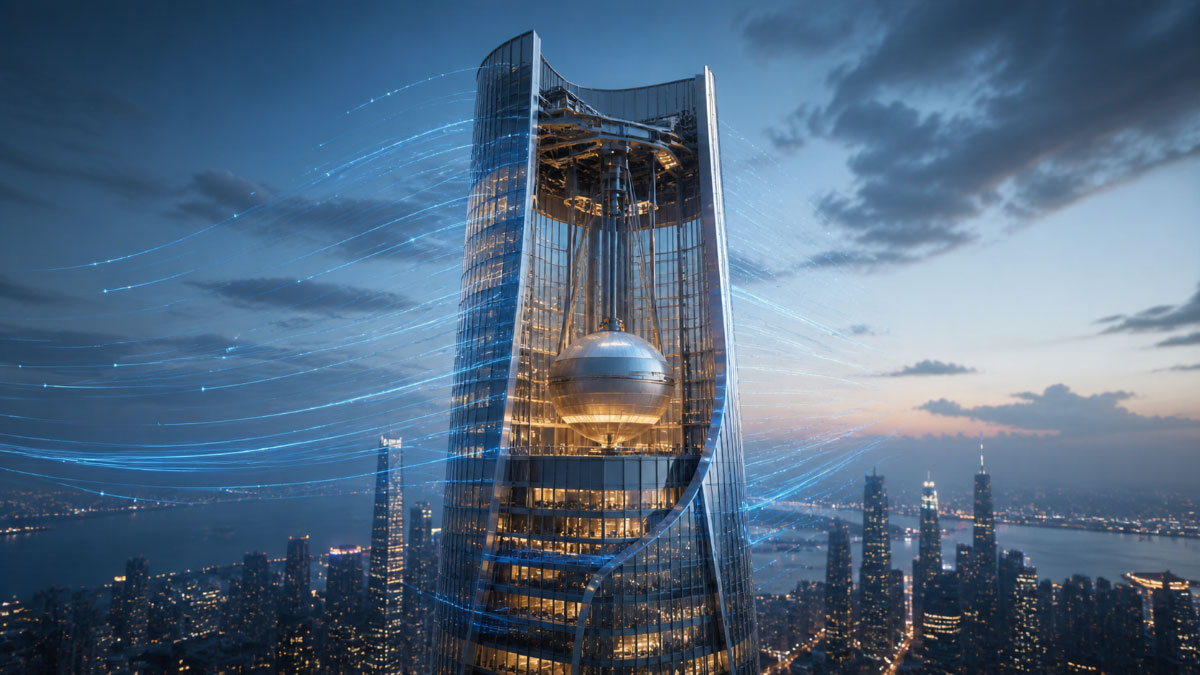
Today, engineers have an arsenal of technologies that act on the structure or its interaction with the environment, ensuring that its critical frequencies are never reached under normal conditions of use. Dampers and counterweights — technically known as tuned mass dampers (TMDs) — devices similar to car suspension, are installed at strategic points to capture and dissipate the energy of the vibration.
The most iconic example is the Taipei 101 building in Taiwan. It features a gigantic 660-tonne steel ball suspended near its top floor. This mass moves in the opposite direction to the wind or seismic movement, thereby stabilising the tower and counteracting its sway before it reaches dangerous amplitudes.
Another strategy involves modifying the structure’s stiffness from the initial design stage. Its geometry or the materials used are altered so that its natural frequency falls drastically outside the range of common environmental forces, such as gusts of wind or passing vehicles.
By Raúl Soriano, senior modeller in the Architecture Department at Amusement Logic