
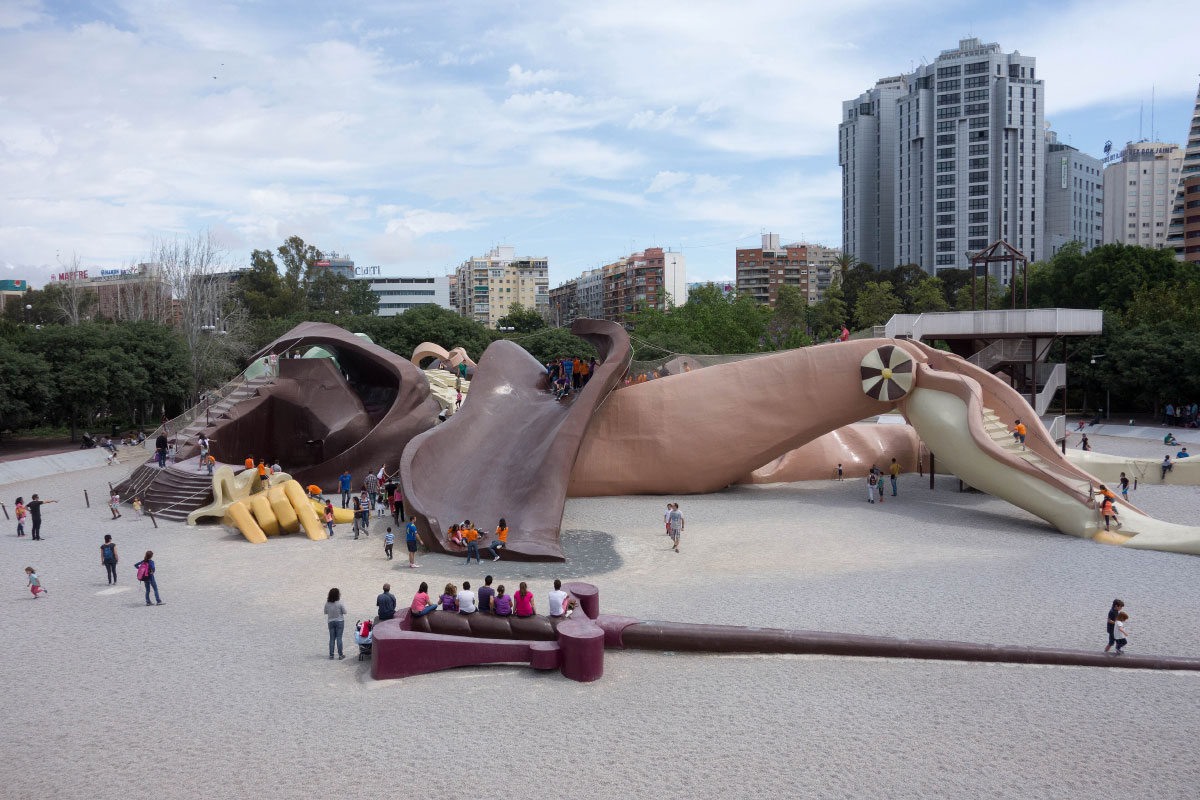
More than 35 years ago, in December 1990, an unusual attraction was inaugurated in the city of Valencia, Spain — one that went beyond what is conventionally understood as a children’s playground. This is Gulliver Park, the place where the giant Lemuel still lies today, besieged daily by hundreds of Lilliputians from the city, who leap across him, slide down his clothing and embark on countless adventures. Gulliver Park, which occupies a prominent position in the Turia Garden — incidentally one of the largest urban gardens in Europe — has since become, for those familiar with it, a clear benchmark in the design of leisure spaces. We dedicate these lines to those who have yet to discover it.
In 1986, Valencia’s municipal architect, Rafael Rivera, was commissioned to design a children’s playground on land within the Turia Garden. Rivera, who had studied parks such as the Garden of Bomarzo in Italy and the work of Aldo Van Eyck in London, United Kingdom, proposed a project that moved away from the usual catalogues of swings and see-saws. His idea was that the play elements should form an inseparable part of the park’s very structure. “I proposed a Gulliver around 35 metres long,” Rivera recalls in statements to the local newspaper Valencia Plaza; “when I approached some sculptors, none were willing to take on the challenge due to the scale of the figure,” he adds.
When Manolo Martín was approached to create it and accepted the challenge, the project was nevertheless initially rejected. It should be noted that Martín was a fallero artist — that is, one of the many designers and sculptors involved in producing the monuments that take centre stage during Valencia’s Fallas festival. Held annually between 1st and 19th March, the Fallas represent a major tourist attraction and, in addition to being designated a Festival of International Tourist Interest — an honorary distinction awarded by Spain’s Secretariat of State for Tourism — they were declared an Intangible Cultural Heritage of Humanity by UNESCO in November 2016. But let us return to Gulliver Park:
Despite this setback, Rivera and Martín soon revisited the idea with a clear conviction: in the initial design, the reclining Gulliver “seemed too dismal”. This led them to conceive a “less realistic interpretation” of the character. It was then that Sento Llobell, a well-known illustrator and comic artist, joined the project. His drawing finally provided what Rivera and Martín had been seeking: a clear, contemporary style that transformed the folds of Lemuel’s clothing into ramps and slides — a design decision that was also functional. “I have a work that appears on Google Maps,” Llobell told Valencia Plaza, “and not all illustrators can say the same.”
The project caught the attention of Pasqual Maragall, then Mayor of Barcelona, who proposed installing it on the city’s beach. However, the chosen location did not convince Rivera and Martín, since “the sand would act as an abrasive on the slide areas”. At that point, the Valencian regional minister for Industry, Commerce and Tourism, Andrés García Reche, stepped in: “When he learned that we were in negotiations with Maragall,” Rivera recalls, “he told us that the project would remain in Valencia, no matter what.”
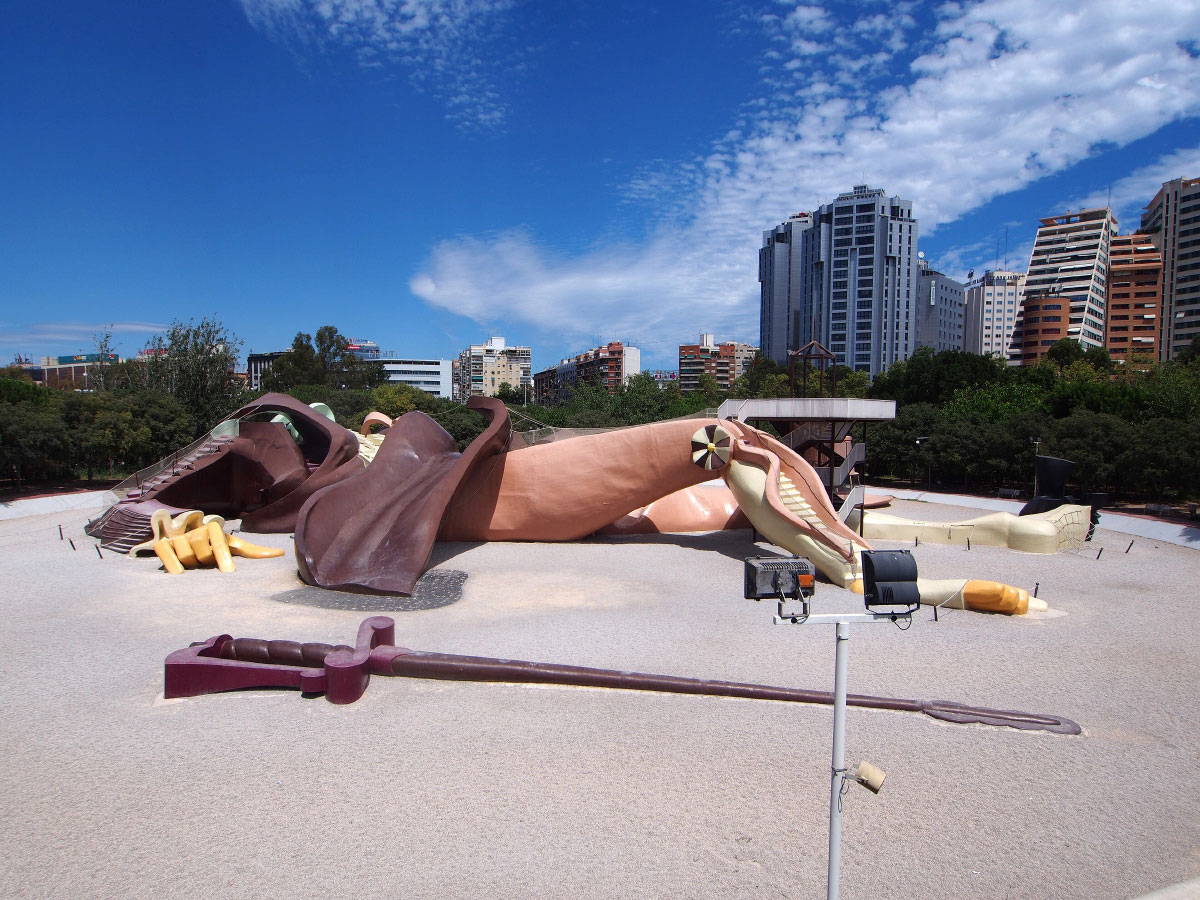
The mayoress at the time, Clementina Ródenas, allocated land in the former riverbed of the Turia — the garden of the same name had just been inaugurated — and the regional government of the Generalitat Valenciana provided the funding. The project, named Un riu de xiquets in Valencian (“A River of Children”), also included additional features such as a giant chessboard and skating areas.
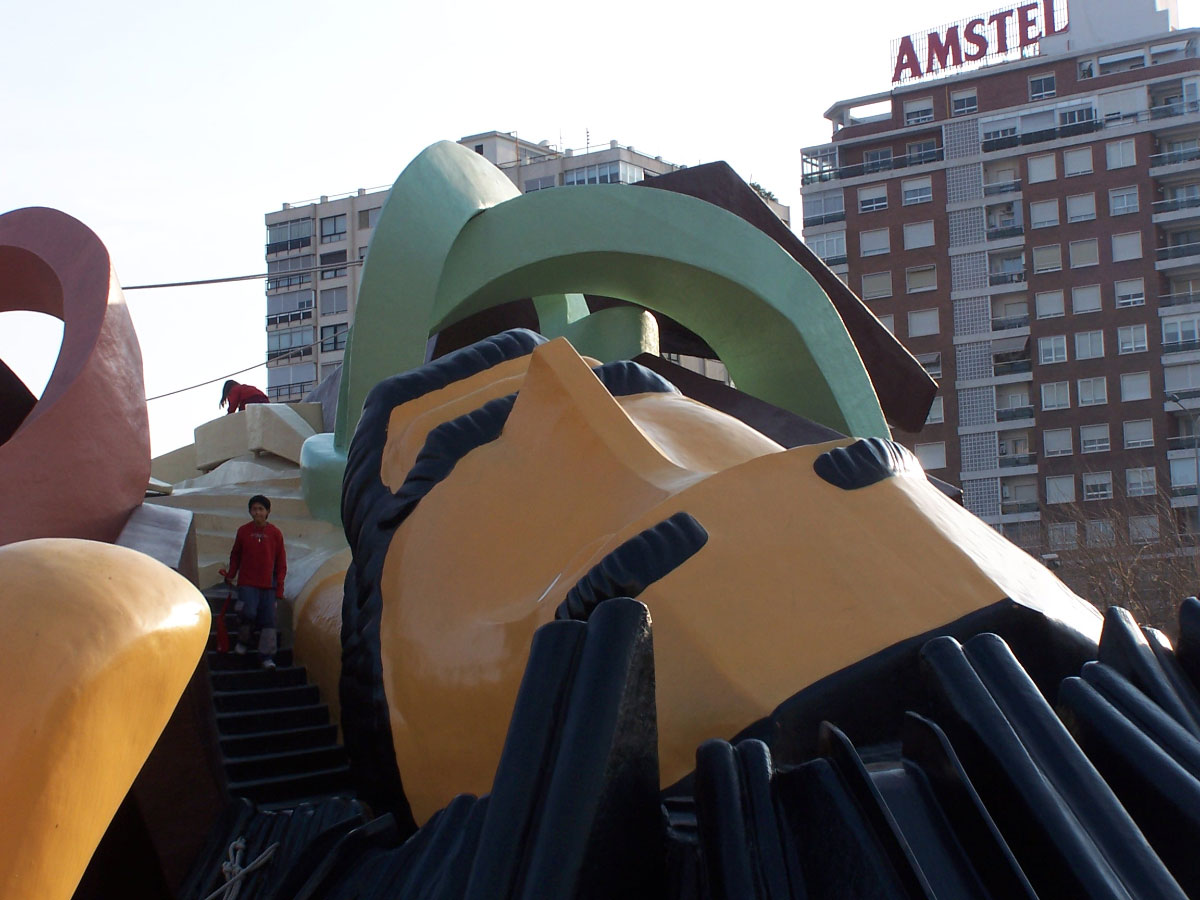
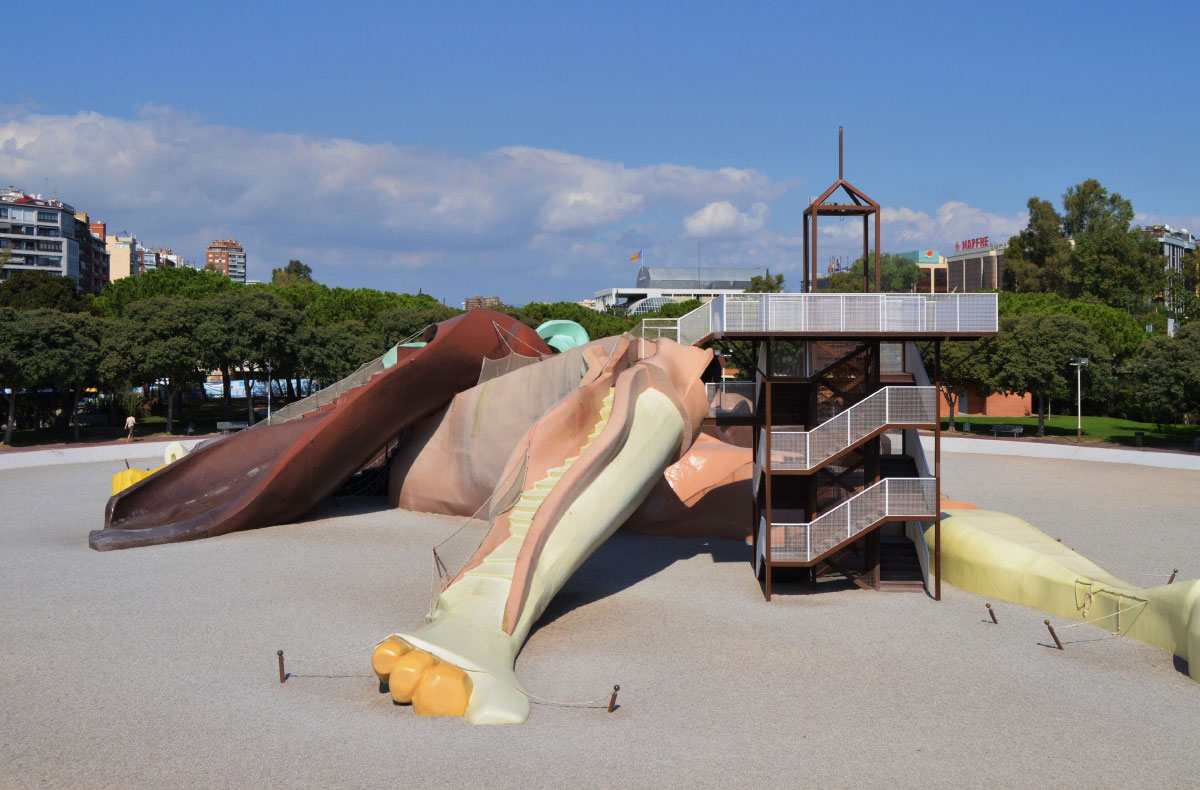
The result, built at a cost of just over €1.3 million, is a park dominated by a comic-style Gulliver measuring 70 metres in length and 7 metres in height at its highest point, with arms, legs and hair that serve as ramps and slides. His shoes, hat and sword complete the route. It is evident that the combination of polystyrene, polyester, fibreglass and sprayed concrete faithfully met the triple objective of lightness, durability and feasibility that guided its construction. The park’s popularity was immediate upon its opening and remains strong today, welcoming around one million visitors each year.
Sources: Valencia Plaza, Levante EMV, Las Provincias, Wikipedia.