
When designing water parks, whilst the pools and water attractions take centre stage, the surrounding landscaping also plays a significant role. In other words, this discipline must be taken into account from the very outset. Let us therefore consider what the landscaping design within a water park should generally entail:
One of the key requirements is that it must ensure universal accessibility. For example, footpaths must be designed with gradients of less than 6%, surfaces must be non-slip when dry and wet (with minimum friction coefficient values in accordance with the UNE-EN 16165 standard or equivalent), and the clear width of the paths must allow two wheelchairs or two pushchairs to pass each other smoothly.
However, landscape design must not focus solely on visitors and users; it must also facilitate day-to-day operations. Elements such as planters, green spaces and trees require planning that takes into account maintenance staff routes, the location of hydrants, technical access to inspection chambers, and safety distances from buried hydraulic or electrical installations.
Furthermore, poorly selected vegetation — particularly small-leaved deciduous species, those with high fruit production or invasive root systems — will cause recurring problems: accumulation of organic matter in the planters and consequent impact on water filtration and treatment systems; lifting of paving; blockage of drainage networks, etc. It is therefore advisable to prioritise low-maintenance evergreen species with minimal leaf and flower production and non-aggressive root systems.
With regard to drainage systems, not only must they be properly sized, but it is also advisable to incorporate permeable paving. This reduces runoff and facilitates sustainable water management.
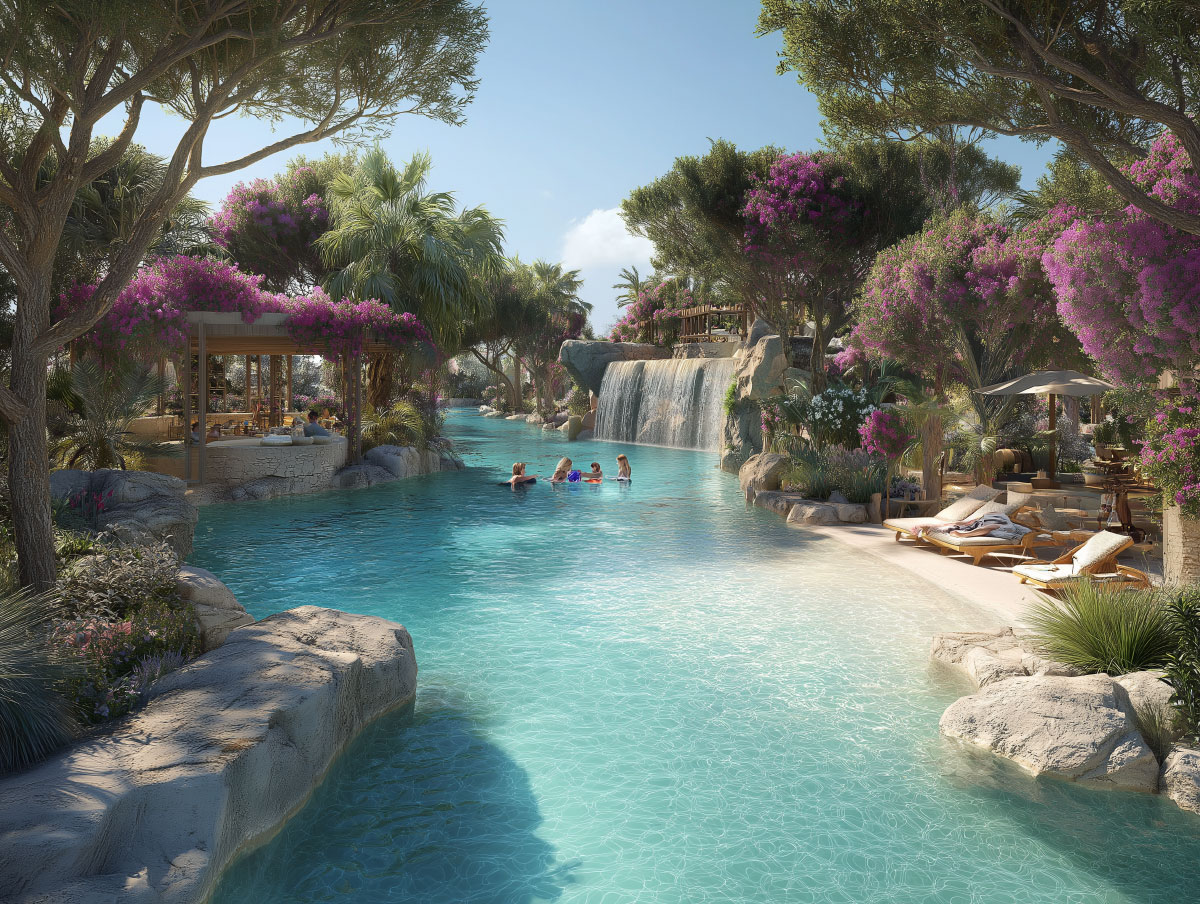
Now, as for shade, whether provided by fixed structures or plant canopies, these must be strategically distributed. To this end, the design of the water park must take into account that they are a determining factor, not only for the landscaping as a whole, but also for the comfort of users and visitors. Their appropriate positioning and orientation will result in extended hours of use of the park; to some extent, it also helps to prevent evaporation from the bodies of water, with the consequent water and energy savings.
In short, as you can see, when the landscape design is coordinated with the park’s aquatic areas from the initial stages of the project, the future visitor experience is enhanced. But that is not all: the resources allocated to its operation and maintenance are also optimised, thereby paving the way for long-term economic and environmental sustainability.
By Francisco Lozano, MEP engineer in the Architecture Department at Amusement Logic