
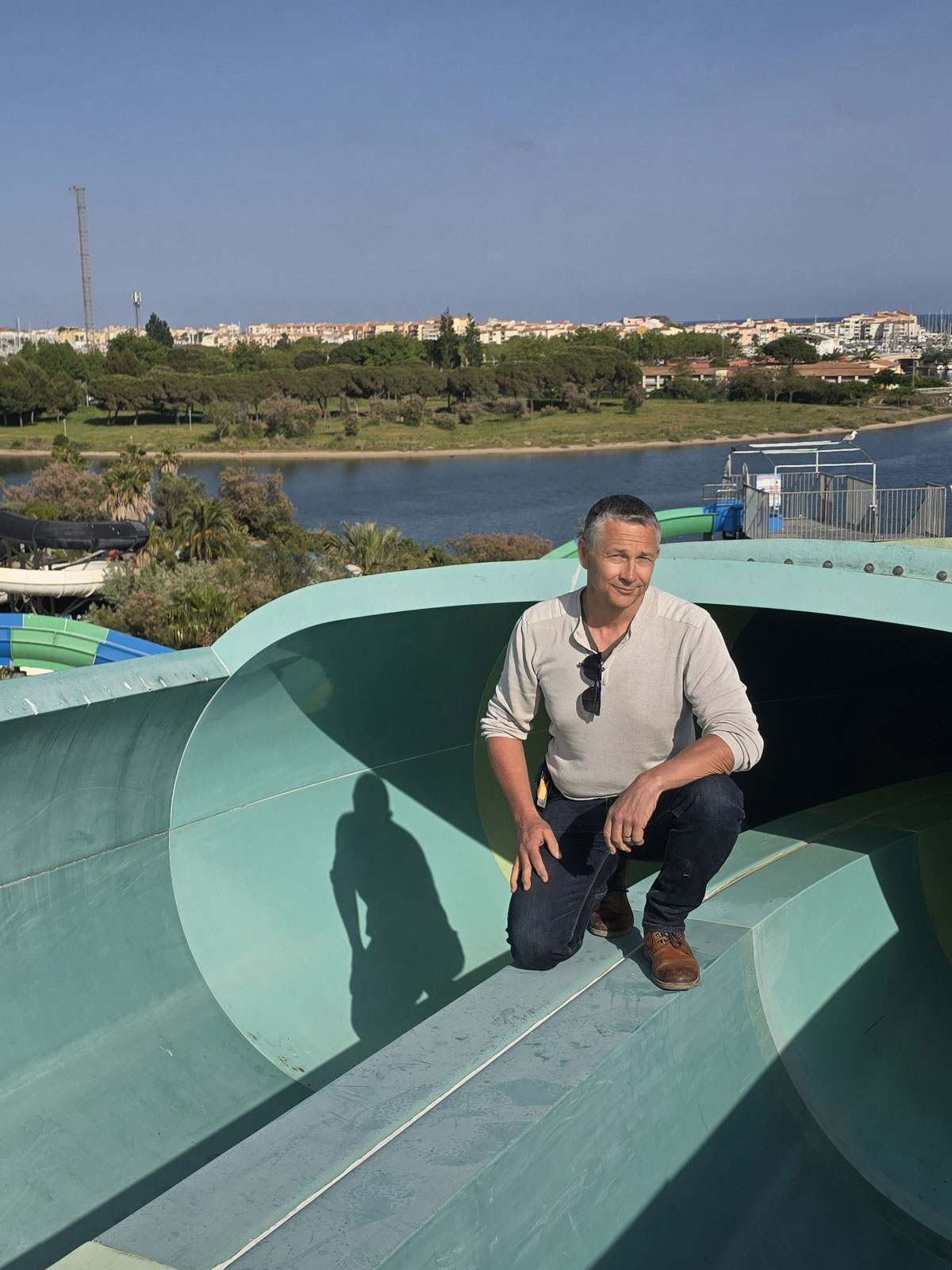
On this occasion, we’re talking with the current operations director of the Aqualand Cap d’Agde and Captain Jako water park complexes. He began his career as a lifeguard and later became assistant director within the Aspro Parks group. With over 25 years of experience in the water park sector, he has managed several facilities in Martinique, Sainte-Maxime and Port Leucate, as well as those in Cap d’Agde. He has made safety and the meticulous preparation of his team the hallmarks of his management approach. For him, each season is an 80-day race against the clock, with no margin for error. Read on — you will enjoy it and, above all, learn from someone who knows what he is talking about.
Amusement Logic: You began as a technical director in a lifesaving club with international swimmers. What motivated you to move from sports technique to managing leisure facilities?
Arnaud Vidor: Managing a leisure facility or leading a sports club with elite athletes requires similar skills. One must be visionary. A sports technical director, like an operations director, must see before others do — see further to anticipate changes in the environment, see higher to perceive what others do not. A technical director focuses on a competition a year ahead and brings swimmers to their peak performance at that precise moment. An operations director anticipates demand, creates new products or services. They must visualise the evolution of their establishment ahead of others.
Another shared quality is strength of character. Even when surrounded by a team, one is often alone. Decisions are made in the solitude of an office; it is alone that training plans and development strategies are devised. It is also alone that one evaluates implemented actions and launches new strategies to reach the next level. Strength of character also means maintaining a steady mindset regardless of ups and downs, showing no weakness, absorbing setbacks, and keeping the team’s motivation intact to achieve set goals. It also means having the determination to tell the truth for the common good of the operation or the club.
Another common element is leadership: motivating and uniting the team, creating a group dynamic, ensuring that each individual, with their diversity and skills, works towards the collective good — because it is together that objectives are achieved.
These two worlds are so closely related that the simplest way to explain water park management is through sport: a high-level athlete prepares for a year for a single competition — their world championship. In the leisure park sector, we prepare all winter to perform during our season.
This competition is even more demanding for a water park, given its extremely short opening period. A leisure park open for six to eight months runs a marathon; if it starts poorly, it can recover later. But we, with just 80 days of operation per year, run a sprint — with no margin for error. The season is so short that any anomaly must be corrected immediately. Pre-season preparation is as important as that of a top-level athlete.
A.L.: You have spent 26 years with the Aspro Parks group, where you started as deputy director. What do you remember from those early years, and how has the company changed since then?
A.V.: My first role at Aqualand dates back to 1991. I started as a seasonal lifeguard to fund my studies. In 1997, I became head of the pool team (60 lifeguards), and soon after head of personnel and deputy director in 2000, when Aspro Parks acquired Aqualand France. Aspro Parks was in a phase of expansion, seeking external growth. Mergers and acquisitions always bring uncertainty and turbulence. However, when properly implemented, they allow each party to enrich its expertise and encourage exchange through collaboration.
Aspro Parks contributed its experience in optimisation and profitability, while benefiting from Aqualand’s 17 years of expertise in water park management. Let us not forget that the first water park built in Europe is the one I currently manage. In 1983, Aqualand Cap d’Agde paved the way for the hundreds of water parks that now exist across Europe. The Aqualand economic model is unique: 80 days of operation to generate a full year’s revenue, with just three permanent staff (director, administrative manager and technical manager) who train and supervise 150 seasonal employees.
Since its construction, the park has constantly evolved. All the original slides have been replaced, catering areas have been repeatedly updated, and new attractions have been introduced. Over 43 years — three generations — when our old clients return with their kids or grandchildren, the park’s transformation has been so significant that they often struggle to recognise it. Continuous improvement remains central, and future investments will follow this strategy.
A.L.: You have managed parks in Martinique, Sainte-Maxime, Cap d’Agde and Port Leucate. What are the specific characteristics of each location, and how does a director adapt to such different environments?
A.V.: These four environments are indeed very different. Cap d’Agde is Europe’s first water park and carries a unique aura. It grew alongside Cap d’Agde, one of France’s and Europe’s major tourist destinations. It is an urban park, half surrounded by residences and half by the sea.
Any new attraction requires major works, as expanding the park’s area is impossible. Access is complex, the ground is permeable (the sea lies less than two metres below), and old attractions must be removed to make room for new ones.
Port Leucate is more modest, one of the smallest of the group, with a limited catchment area and strong competition from campsites. Sainte-Maxime, in the Gulf of Saint-Tropez, serves a denser and more affluent clientele demanding higher-quality services. Martinique is different still — not part of Aspro Parks, created by local Martinique investors who sought Aqualand’s expertise during construction and early operation. Managing an island park requires a distinct strategy.
How does one adapt to such diverse environments? Just as a technical director would. You assess the existing system and analyse the strengths and weaknesses of each area of operation. In financial terms: the catchment area, the type of clientele, their purchasing power, their background, suppliers and negotiated rates, the competition… In terms of operations: the services, how they operate, job descriptions, and the roles and responsibilities of each employee and manager. Regarding structural and technical aspects: every park is technically different. You need to assess the condition of the facilities, quantify and prioritise investments, maintain the operational infrastructure, and ensure the safety of equipment and customers… Finally, on the political front: establishing contact with local authorities, the council, the tourist office, the regional health agency, the departmental government service…
Next, objectives and action plans must be defined for each sector. To adapt to such diverse environments, it is essential to make the correct assessments.
)A.L.: You have been operations director at Cap d’Agde for 16 years. What does your day-to-day role involve, and how do the two parks compare?
A.V.: Aqualand receives between 170,000 and 220,000 visitors over 80 days, across 3.8 hectares, with 150 seasonal staff. Captain Jako is aimed at children aged 1 to 8, with 15,000–18,000 visitors over 60 days on 1,800 m² and 14 seasonal staff. There is no routine in our business. Each season requires analysing the strengths and weaknesses of the previous one to better prepare for the next. Aqualand is the flagship attraction, the one that attracts the most attention. Captain Jako caters to a niche market: families with young children looking for a peaceful experience. It operates as a separate entity with its own distinct characteristics: a smaller catchment area, a catering service tailored to its surroundings, and a higher standard of services.
A.L.: Given your background in lifeguarding, how do you approach prevention and team training?
A.V.: Safety must be an absolute priority, especially in water parks. Naturally, children play in the water and have no sense of danger; yet a child who slips away from their parents’ supervision can drown in less than 10 cm of water in under 20 seconds, even without making a sound. It is crucial that all attractions are constantly supervised by qualified staff.
Having a background in lifesaving and having worked as a lifeguard at this park, I have gained a good understanding of the ‘pool safety’ service. This service is the most important in terms of both the number of staff involved and the responsibilities involved. The rescue team consists of two pool supervisors, a qualified nurse, 35 lifeguards and 25 first-aid assistants. My background as a lifeguard naturally influences my management style. I am open to dialogue and discussion with the lifeguards, but I am firm when it comes to ensuring instructions are followed.
Twice a season, we organise drills and first-aid workshops with the whole team. Every morning, a briefing is held to go over the rules and discuss the previous day’s events. These discussions are important for engaging and empowering the lifeguard team and keeping them alert to potential risks. Safety is a priority: 43 years of operation, over 8 million visitors and no drownings.
A.L.: Seasonality is a major challenge. How do you organise a year when activity is concentrated into just over two months?
A.V.: Every new season is a new challenge. Every off-season is a preparation phase. In autumn, the main focus is on administrative tasks: closing the accounts for the previous financial year and preparing the budget for the next one, as well as initiating the consultation process with external companies and stakeholders. Engines and pumps are dismantled and serviced. In winter and spring, the focus is on preparing and reactivating all services: defining and implementing action plans for each department – administration, sales, catering, shop, ancillary and technical services, etc.; getting the park ready: cleaning and painting all the pools; ordering supplies: shop stock, chemicals, communications materials, etc.; preparing and implementing the communications and marketing plan; and recruiting and training staff.
The three months leading up to the park’s opening are crucial. Why? Because in winter, Aqualand Cap d’Agde is a real dormant powerhouse. The hardest part is getting it back on track and on the right path to achieve our objectives. If the preparatory work is done properly, everything falls into place naturally.
In conclusion, Aqualand Cap d’Agde involves 10 months of preparation for a two-month sprint during which there is no margin for error; the turnover for the whole year depends on those 80 days of operation.
A.L.: You have always worked in well-established tourist destinations. How does reliance on international tourism affect the management of a park such as Aqualand Cap d’Agde?
A.V.: Although the water park is located in the heart of one of Europe’s leading tourist destinations, Aqualand Cap d’Agde is not heavily reliant on international tourism. 80–85% of our visitors are French. The repeat visitor rate from one season to the next is higher here than at other parks; the park’s longevity and reputation may explain this rate. Neighbouring countries in Northern Europe make up the majority of our international clientele. The repeat visitor rate for this group is low because they are mainly passing visitors.
Geopolitical conflicts, rising fuel and airfare prices, economic crises, and even the health crisis we are experiencing with COVID-19 directly affect the management of a park and the profile of its visitors. It is therefore the responsibility of the director and the group to implement measures to absorb these short-term shocks.
A.L.: After 23 years as operations manager, you must have experienced all kinds of seasons: good, bad and unusual. Which season did you find the most difficult, and why?
A.V.: ‘A great season’, as we like to say in the trade, won’t automatically be synonymous with a difficult season if the whole team stays united and committed in the face of challenges. In June, the whole team sets sail on a ship called ‘Aqualand’. As captain, I must recruit and train the crew, chart the course and make decisions on the direction to take. We’ll face storms and reefs; a season isn’t a long, calm river. I’ve experienced the ‘COVID-19 seasons’, park openings with construction work still being finalised, amidst customers in swimwear, technical rooms flooded under 1.80 metres of water, sleepless nights helping the technical team repair an attraction…
You can’t do the work of two people on your own, but between two of you, you can do the work of three. With a united team, motivated by a shared project, you can weather any storm. So I’d say a season becomes difficult when tensions arise within the team.
A.L.: How has the profile of water park visitors changed over the past two decades? And, in parallel, how have the parks had to adapt (in terms of attractions, theming, experiences and services) to meet this new demand?
A.V.: A leisure park must evolve: first and foremost, to satisfy its visitors, listen to them and offer something new so that every family leaves the park with a smile. Secondly, to keep up with the competition. Let’s not forget that 20 years ago, water parks were the leaders in the water leisure sector, but since then the range of options has expanded: campsites have improved their quality, and large campsite chains are highlighting their water parks to attract more campers. We have also seen the emergence of leisure areas with inflatable structures and water slides. We must respond to this competition. We are obliged to anticipate developments, to improve quality with new services, new attractions and new shows.
Over the past two decades, the profile of visitors has changed little. Families and young people remain our core target audience. Whilst our target audience remains stable, it is important to note the constant evolution of our customers’ expectations. They are seeking increasingly thrilling and immersive attractions, as well as personalised or even high-end services. To meet these expectations and thereby increase the return visitor rate, water parks must absolutely continue their drive for innovation.
I believe it is important to highlight a key factor that has influenced the development of parks over the past 40 years: social change. Over the past 40 years, society has become more litigious; the filing of complaints has become widespread, particularly due to the widespread use of digital tools, artificial intelligence and the ubiquitous presence of smartphones, which facilitate the instant sharing of images on social media, making it increasingly difficult to control. This new dynamic is accompanied by a growing quest for visibility and noise, often to the detriment of information and safety. As a park manager, it is essential to be aware of this development.
Whereas 40 years ago, the construction of an amusement park was based on an empirical approach, today the sector is subject to an absolute requirement for reliability and compliance. Ride manufacturers now use simulation tools and supercomputers to minimise the risk of accidents and meet the new, very strict safety standards. The result: safer, better-controlled rides with fewer accidents than before.
A.L.: Looking ahead, what challenges face the Mediterranean waterpark sector?
A.V.: In the future, water parks in the Mediterranean will face numerous social and regional challenges… but the main challenge will be environmental. With global warming, Mediterranean regions have undergone profound changes over the last 10 years. Droughts are becoming more frequent and longer-lasting, aquifers are shrinking, forest fires are becoming uncontrollable, and water stress is increasingly prevalent. Population movements are creating new water needs. Regions around the Mediterranean basin are seeing their populations grow. Furthermore, most tourist destinations are concentrated along the coast. The influx of summer tourists increases the demand for water at the worst possible time.
Water parks must anticipate these environmental changes and start implementing a plan to reduce their water consumption now. Three years ago, we began this transition at Aqualand Cap d’Agde. We carried out an assessment of the park and established three action plans: short-term measures, which are easily achievable; medium-term measures, involving more complex technical resources; and long-term measures. This final phase requires, firstly, monitoring of regulatory developments and, secondly, engaging in dialogue with the authorities to bring about changes in the regulations and secure funding.
To be able to make proposals to the authorities, French water parks have formed a committee within the National Union of Leisure and Cultural Activities Establishments. We share our challenges and experiences to be proactive and play a part in shaping the evolution of regulations. The issue of water management is currently at the heart of our discussions.