
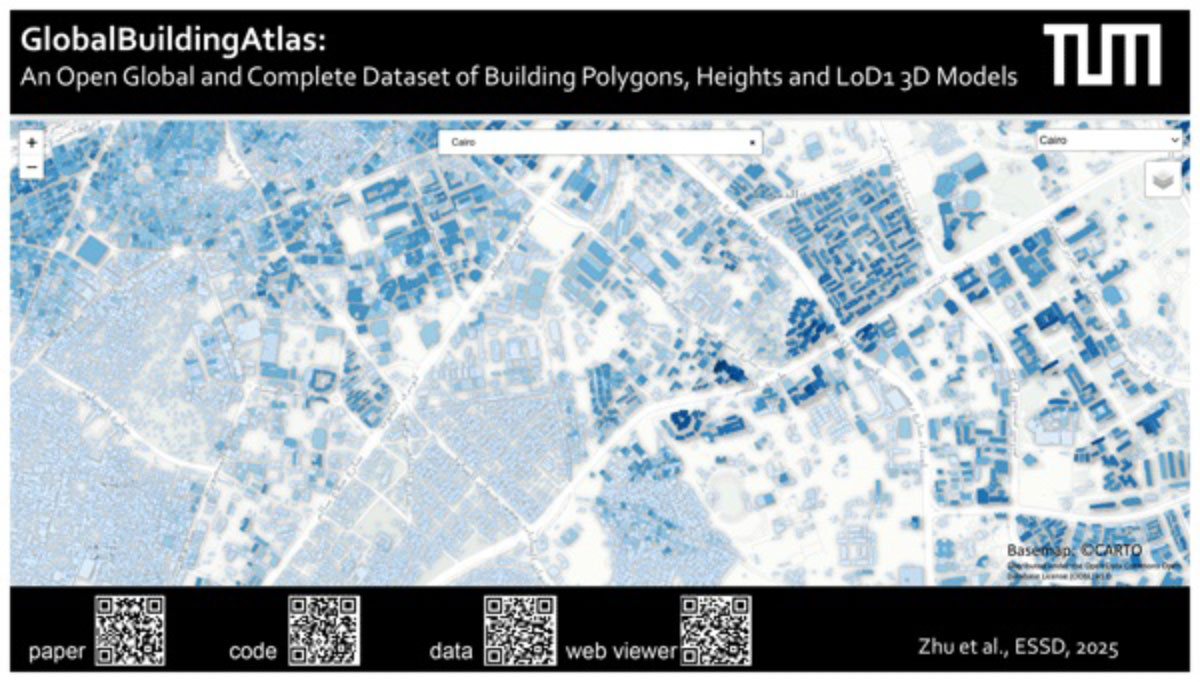
A team of scientists comprising Xiao Xiang Zhu, Sining Chen, Fahong Zhang, Yilei Shi and Yuanyuan Wang from the Technical University of Munich, Germany, has created the most comprehensive three-dimensional atlas of buildings on the planet to date: the GlobalBuildingAtlas. This consists of a database that collects information on 2.75 billion buildings—according to the researchers’ own estimate, 97% of all structures built—and provides not only their location, but also their height and volume, with an unprecedented level of detail.
How the map was built
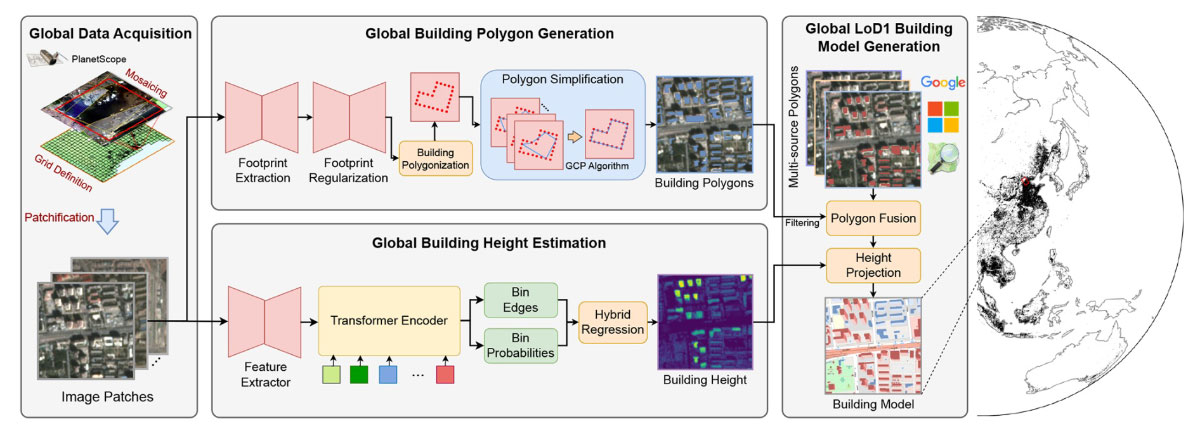
Unlike tools such as Google Maps or Apple Maps, which are based on aerial photographs and 2D models, GlobalBuildingAtlas combines high-resolution satellite images with machine learning techniques to generate 3D models.
The researchers used around 800,000 images captured in 2019 by the PlanetScope satellite constellation, with a spatial resolution of 3 × 3 m. Using neural networks trained with LiDAR data—an aerial laser scanning technology—from 168 cities, mainly in Europe, North America and Oceania, the system predicted the height of each building, even in areas where no direct measurements exist. The result is a three-dimensional LoD1 (Level of Detail 1) model, which is equivalent to the representation of the basic shape and height of each structure in 3D, but without complex architectural details such as roofs or façades.
What is the purpose of such a map?
Beyond cartographic curiosity, this atlas has practical applications in various fields:
-In urban planning and development, as it allows for the analysis of building density, the volume built per inhabitant, and spatial distribution in cities.
-In risk assessment, because it facilitates studies on vulnerability to natural disasters, such as floods or earthquakes, by providing information on the built-up area in risk zones.
-In monitoring sustainable development, by virtue of the volumetric metrics it offers, which complement the UN indicators on sustainable cities.
-Finally, in tourism and leisure, as it provides an overview of urban morphology, useful for planning routes, designing experiences, or analysing destinations from a spatial perspective.
Limitations and differences with other maps
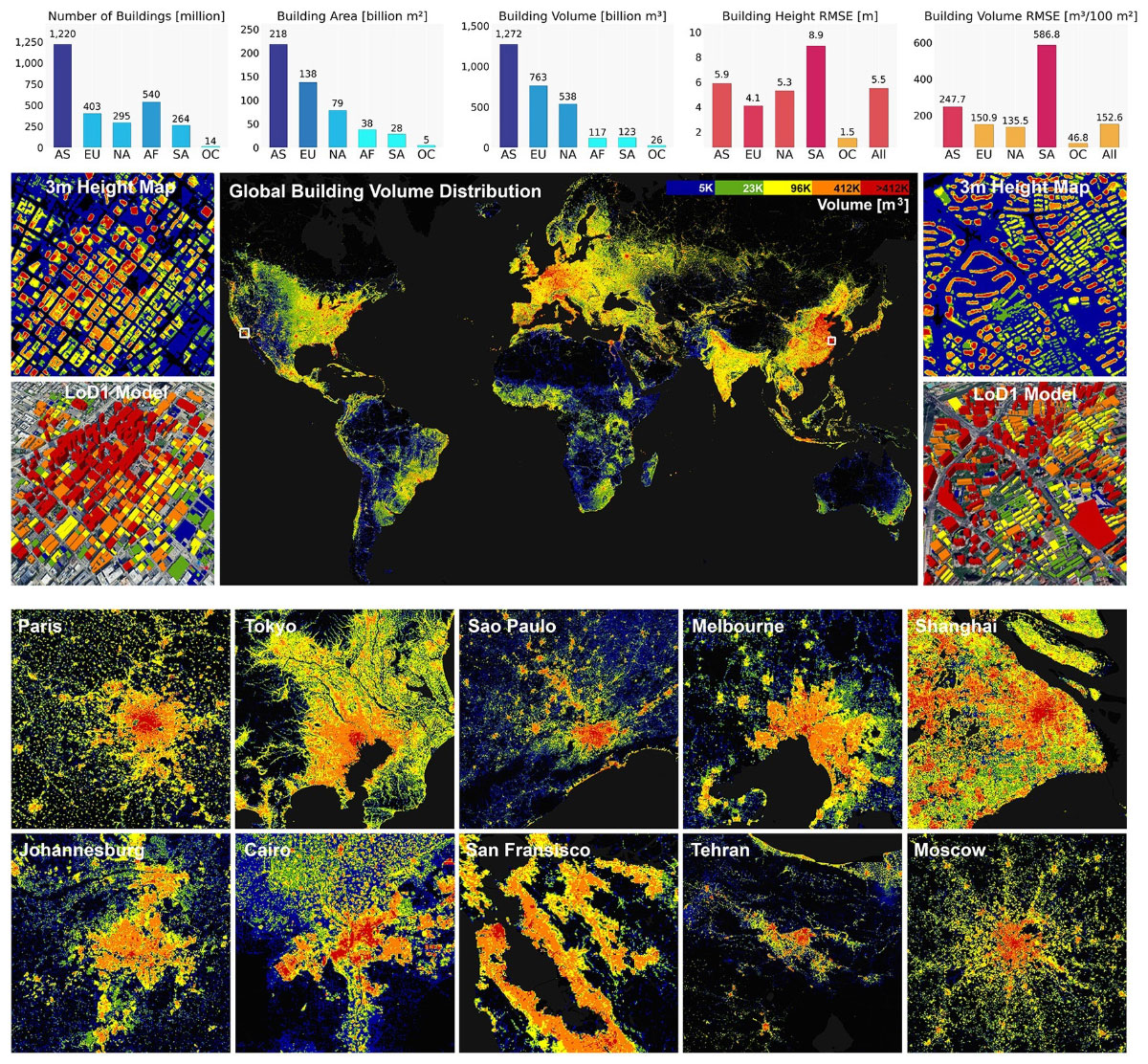
Despite its global ambition, GlobalBuildingAtlas has certain limitations inherent to its methodology. In this regard, we must point out that the accuracy of the data is not uniform; for example, the height of skyscrapers is often underestimated, and in regions such as Africa and South America, errors are more pronounced due to the scarcity of available training data.
Although its 3 m resolution, as we mentioned, is a major advance—it is 30 times more detailed than previous models—it is still insufficient to capture architectural details or complex elements of buildings. In addition, temporal coverage is currently limited to images from 2019, which leaves out the most recent constructions. In any case, the GlobalBuildingAtlas can be updated periodically.
In any case, the Technical University of Munich’s model does not seek to replace Google Maps, but rather to complement it with a layer of volumetric information. While Google Maps offers navigation, business details and street photographs, this atlas focuses on the massive geometric representation of buildings.
A look at the numbers
Some of the data provided by the 3D map is revealing and helps us to gain perspective on global urbanisation. Asia emerges as the continent with the highest building density, accounting for nearly half of all registered buildings—some 1.22 billion—and, as if that were not enough, it also leads in terms of total construction volume within its territories.
In contrast, Africa, although it has a high number of buildings (540 million), has a significantly lower aggregate volume, indicating the predominance of low-rise and small structures.
Within Europe, the map reveals marked internal inequalities: Finland, for example, has a building volume per person six times higher than Greece, reflecting a stark contrast in the intensity and model of urban development between countries on the same continent.
Access and future
The GlobalBuildingAtlas database is openly available for non-commercial use, and researchers encourage the community to use and improve it. Furthermore, its code and methodology are public, facilitating future updates and sector-specific applications.
For professionals in tourism, leisure, entertainment, architecture, or real estate development, this map, beyond its technical curiosity, is a spatial analysis tool that allows cities to be understood not as plans, but as inhabited volumes.
You can access the 3D atlas here: GlobalBuildingAtlas.
If you would like to know more, we encourage you to delve into our sources, especially the in-depth publication of the research in Earth System Science Data.
Sources: Earth System Science Data, Nature, Science Alert.
Images: Earth System Science Data.