
In the architecture and construction of leisure and tourism projects, infrastructure — such as swimming pools, water parks, theme parks, hotels and resorts, etc. — is often exposed to intense stresses or harsh environments. Whilst external reinforcement with carbon fibre sheets or fabrics is a well-established technique for withstanding such challenges, innovation in materials is opening up new frontiers. In this case, we are going to discuss the direct incorporation of carbon fibres into the concrete matrix, or Carbon Fibre-Reinforced Concrete (CFRC).
Research published in *Scientific Reports* concludes that adding carbon fibres to the cement matrix not only increases its mechanical strength but also improves its behaviour against environmental degradation agents. Furthermore, the tests identify the optimal dosage threshold as around 0.4 per cent carbon fibre. At this dosage, compressive strength increases by 15.02 per cent compared with conventional concrete. However, above this limit, the excess fibre reduces the cement’s cohesion and diminishes its strength.
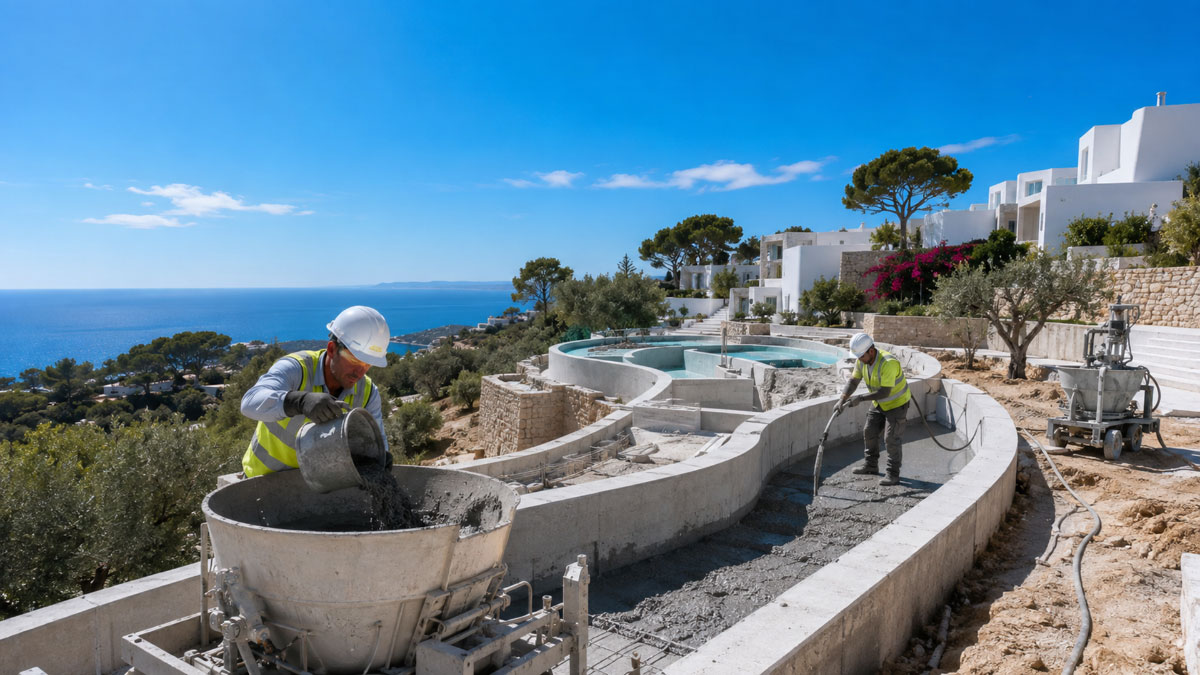
Tensile behaviour improves significantly even further: with 0.4 per cent carbon fibre, the tensile strength of the concrete increases by 51.12 per cent, whilst at a concentration of 0.2 per cent, the improvement is 41.32 per cent, and 46.26 per cent for a dosage of 0.6 per cent. This reinforcement is due to the microfibres’ ability to bypass microcracks, distribute stresses and, consequently, delay structural failure.
As expected, CFRC also offers improved durability. After 100 cycles of immersion in chlorides and repeated freezing, its mass loss was 0.90 per cent, compared with 1.63 per cent for conventional concrete. Furthermore, impact tests using a Split Hopkinson bar confirmed superior resilience to dynamic loads.
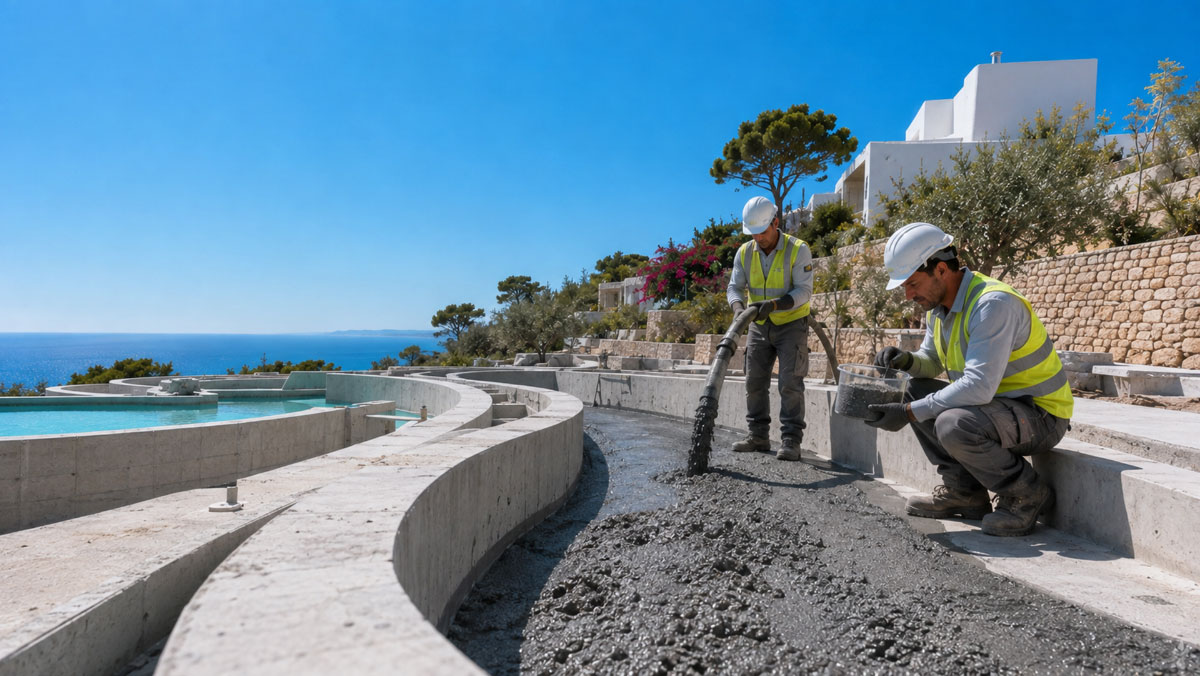
The application of CFRC in the architecture and construction of leisure and tourism projects looks promising: in bodies of water and marine environments, chloride resistance reduces corrosion of reinforcement and delays the appearance of cracks; in climates with wide temperature ranges, surface degradation is minimised, whilst maintenance costs are reduced.
By Raúl Soriano, senior modeller in the Architecture Department at Amusement Logic