

In recent years, various cities around the world have begun to incorporate three-dimensional graphic elements into streets and pedestrian crossings with an aim as simple as it is effective: to catch drivers’ attention and encourage them to slow down. The results have shown that, on occasion, an optical illusion is more effective than a traffic light or a conventional speed bump.
The key to their effectiveness lies in the element of surprise. A zebra crossing that appears to be a raised platform, an animal that seems about to cross the vehicle’s path, or an urban feature emerging from the tarmac, all take the driver by surprise and, as a result, trigger an instinctive, reflexive braking response.
Indeed, Amusement Logic’s 3D-Tech technology takes this concept a step further. This on-demand modelling technology produces highly realistic, customised three-dimensional figures. Animals, urban elements, geometric shapes and themed designs alter the driver’s perception and, as we can see, encourage more cautious driving.
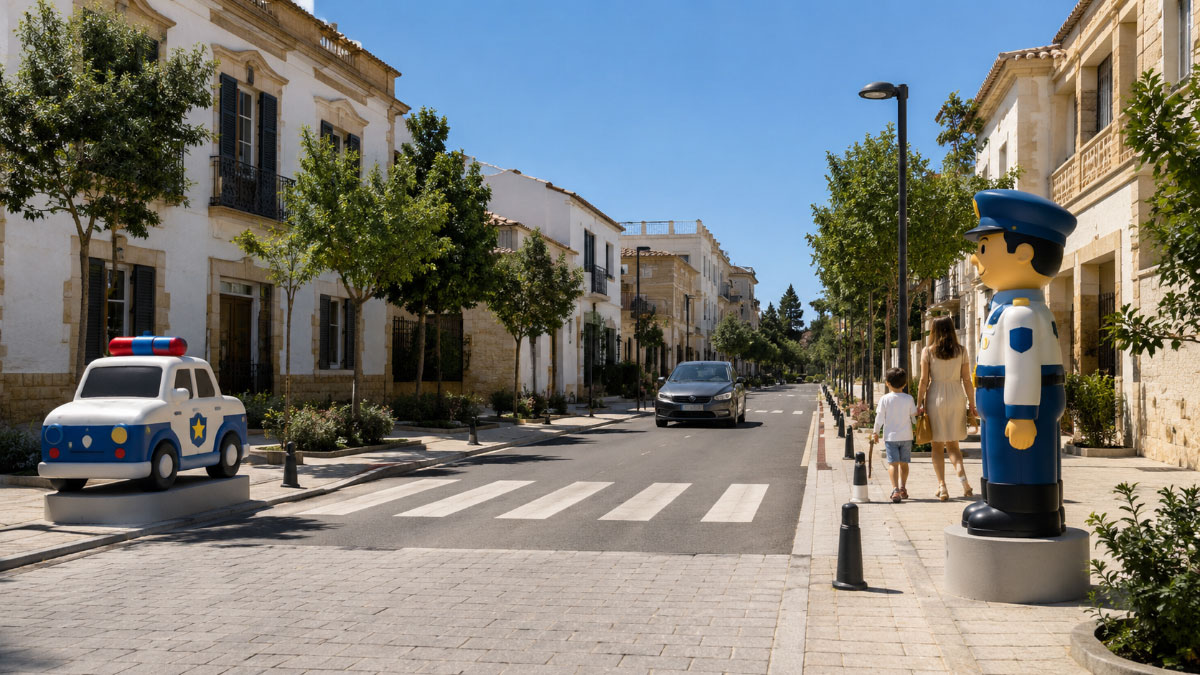
But in addition to the preventative function mentioned above, the three-dimensional figures produced using the 3D-Tech modelling system also enhance the beauty of the surroundings. After all, they transform everyday spaces — which are often bland or run-down — into more attractive, memorable places with their own unique character.
There is no doubt that the use of 3D figures is an innovative solution for managing traffic. As you can see, safety and creativity go hand in hand thanks to this urban initiative. They improve both public safety and the experience of getting around the city. This concept is particularly well-suited to sensitive areas such as school zones, pedestrian areas and busy urban locations.
By Pablo Vidal, senior architect in the Architecture Department at Amusement Logic